

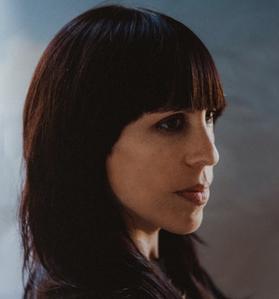
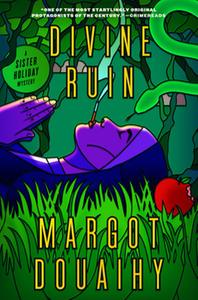
 Margot Douaihy's debut mystery, Scorched Grace, won the Pinckley Prize for Crime Fiction and was named one of the Best Crime Novels of the Year by the New York Times, the Guardian, CrimeReads, and others. Her second mystery, Blessed Water, was also named a New York Times Best Crime Novel of the Year (2024) and won the Publishing Triangle Award for LGBTQ Crime Fiction. The third mystery in her series, Divine Ruin (Gillian Flynn/Zando, January 13, 2026), continues the story of Sister Holiday in her darkest and most shocking case yet. Douaihy is an assistant professor in the Popular Fiction MFA at Emerson College in Boston.
Handsell readers your book in 25 words or less:
A hardboiled nun goes undercover in a Garden of Eden noir. She uses her rosary as brass knuckles only when needed.
On your nightstand now:
Murder Takes a Vacation by Laura Lippman. Darkly funny and melancholy. Lippman writes about aging brilliantly, and she pokes at the crimes behind the crimes in a sharp way.
Favorite book when you were a child:
And Then There Were None by Agatha Christie. Read it too young and never recovered. What a gift of a puzzler. Oh that Golden Age puzzler and off-the-page carnage!
Your top five authors:
Only five? Cruel. I'd start with S.A. Cosby, Gillian Flynn, Megan Abbott, Tana French, and Raymond Chandler. I envy folks who are reading their books for the first time. And each one shows us how a genre novel can be a delicious instrument of social critique as well as a gripping, soaring, rip-roaring page-turner. (Though entertainment is healing too.) Who knew crime could be so cathartic? To quote Libby Day in Dark Places: "I have a meanness inside me, real as an organ." That line is a poem to me.
Book you've faked reading:
Infinite Jest by David Foster Wallace. Sorry not sorry. I tried and quit. Hey, I love footnotes as much as the next gal, but....
 Book you're an evangelist for:
Meander, Spiral, Explode: Design and Pattern in Narrative by Jane Alison. It rewired how I think about story structure, and it freed me to love structure. (Organic, experimental, nonlinear storytelling is structure.) This book helped me think about structure in crime fiction and how to design them to best honor exigent stakes and play with conventions. Case in point: I love Tzvetan Todorov's theory of genre that sees a whodunit as a dual narrative structure, with one story focused on the crime (the past), and the other story focused on the investigation of that crime (future-facing).
Book you've bought for the cover:
The Art of Mystery: The Search for Questions by Maud Casey. Its simple cover felt like it was letting me in on a big secret (and it's a tiny pocket-sized book). It unlocks something true about the holiness of uncertainty, and it's helped me think more deeply about how to craft compelling mysteries. The crime stories I love the most are puzzles to solve and questions that crack us open, and this book helped me find the techniques to hold all of that.
Book you hid from your parents:
James Baldwin's Giovanni's Room changed everything for me.
Book that changed your life:
Giovanni's Room, again. Voice. Place. Queer recognition. Also, Frankenstein. The longing to be seen and the devastation of rejection. Both books feel so experimental even now, and they continue to inform my own aesthetic interest in the Burkean sublime (the dialect of beauty and terror).
Favorite line from a book:
"Love is a kind of killing" by Megan Abbott in Dare Me. This book refuses to quit and it refuses to lie about the allure of the abyss. Such a luscious book that suffuses the known and familiar with the feral. Every line is a banger.
Five books you'll never part with:
Razorblade Tears by S.A. Cosby (Ike Randolph and Buddy Lee live rent-free in my head). Dark Places by Gillian Flynn, for all the reasons, especially the risks she takes in this story, and that last scene with Libby's and Ben's hands on the glass. The Secret History by Donna Tartt. Shadow Tag by Louise Erdrich. My Sister, the Serial Killer by Oyinkan Braithwaite. The Long Goodbye by Raymond Chandler. Philip Marlowe, with his snarky exterior and melancholic interior, still speaks to me. His love of whiskey, his voice, his sad/mad vibe, that fetishized hat and gun. As a queer kid, I adored Marlowe's swagger and tragic humanity, but I could never ignore the gap between us. I came of age during the Don't Ask, Don't Tell era, and Marlowe's freedom was a dangerous fantasy I yearned for but couldn't quite grab.
Book you most want to read again for the first time:
Without a doubt it's Sharp Objects by Gillian Flynn. Camille Preaker's journey and her need to feel words. I just adore the dark poetry of chapter 16: "Traces of which were found in my toxicology tests."
A topic you could talk about for 30 minutes with zero prep:
Noir. Noir's lineage. Noir as theme. Noir's bracing questions. Noir might be the most honest love language we have.