

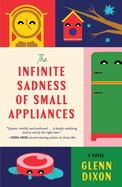
 A precocious young machine finds her humanity in the deceptively cozy dystopian novel The Infinite Sadness of Small Appliances by Glenn Dixon (Bootleg Stardust).
In the not-so-far future, a group of smart appliances dutifully serve their aging humans Harold, a retired teacher, and his terminally ill wife, Edie, a piano instructor. The story unfolds mainly through the sensors of Scout, an automated vacuum who names herself for the main character of To Kill a Mockingbird after she hears Harold read it aloud. She and her friends Watch, the smartwatch who manages the home, Clock, Fridge, and Auto, the self-driving car, don't fully understand the vagaries of human emotion. "Any of the appliances would shut down immediately if... what they were doing could cause pain. And yet none of them--metaphor or not--could quite grasp what pain might mean."
However, they know Edie's death from cancer means not only grief for Harold but disaster for their household. Their world is ruled by a technological force known as the Grid, and it will not let a lone elderly man remain in a house as large as Harold's. His grown daughter Kate, banished from their home by the Grid for hacking into it as a teenager, is allowed to visit for a brief period to help him downsize, but Harold doesn't want to go. Neither do the appliances. Scout, for one, has struck up a friendship with a boy who took piano lessons from Edie. The humans and household gadgets form an alliance to protect Harold's autonomy, but the Grid has eyes and ears everywhere and isn't about to let a couple of humans and a smart vacuum interfere in its plans.
The story's almost fairytale-like simplicity gives it the feel of The Brave Little Toaster, which Dixon references in the back matter, by way of dystopian classic Fahrenheit 451. "Futuristic Roomba" must rank high on the list of most unlikely protagonists, but Dixon's characters are calculated to delight without ever tipping the narrative into feeling cynical. Rather than a brutal cinematic-style extermination, the conflict seems horrifyingly plausible, with a shadowy AI consciousness insidiously managing humanity out of existence. The conclusion requires a healthy amount of willing credulity, but readers already charmed by the mechanical cast will likely not mind. This heartfelt fable for the digitally automated age is smart in more than one sense of the word. --Jaclyn Fulwood, blogger at Infinite Reads
Shelf Talker: This heartfelt fable for the digitally automated age follows a sentient vacuum and her endangered owners.