

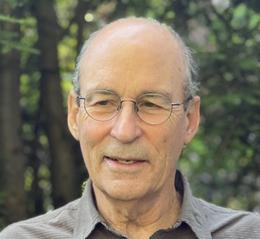
Tracy Kidder, "a wide-ranging journalist and author whose deep reporting and novelistic prose illuminated worlds as diverse as home construction, disease prevention and--as portrayed in his prizewinning 1981 breakthrough book, The Soul of a New Machine--the computer industry," died March 24, the New York Times reported. He was 80. Kidder "highlighted people who had mastered their realms, placing them as characters in accounts that rang true because they were based on staggering amounts of research."
 |
|
| Tracy Kidder | |
For Among Schoolchildren (1989), he spent a school year in a Massachusetts classroom. For Mountains Beyond Mountains: The Quest of Dr. Paul Farmer, a Man Who Would Cure the World (2003), he followed Dr. Farmer, founder of Partners in Health, an organization that provides care to some of the world's poorest people, to his hospital in Haiti as well as to Peru, Cuba, and Russia. House (1985) depicted the process of planning and building a home, focusing on the relationships between owners, architects, and builders.
The Soul of a New Machine, which won a Pulitzer Prize and the National Book Award, "introduced readers to the physical parts and electronic bits that go into creating a business computer. The book arrived just as the PC revolution was gearing up," the Times wrote, adding that when he took on the project, Kidder told a reporter for the Times that he was not familiar with the field and relied on his subjects at Data General Corporation to teach him.
"Some of them despaired over my lack of technological background," Kidder said, "but most of them were pleased that an outsider was interested in what they were doing." While he worked to get the technology research right, Kidder said he cared most about "the people themselves, their incredible passion for this thing."
At Harvard, Kidder took a creative writing course from the poet and translator Robert Fitzgerald, who, he said, "made me feel that writing could be a high calling, possibly available to me."
During the Vietnam War, he spent a year monitoring radio transmissions in the rear echelon. "His service, he recalled in an interview for his obituary last year, did not make the impression on him that it had made on writers like Tim O'Brien, who created masterpieces from their war experiences," the Times noted.
On his return he wrote a war novel, Ivory Fields, that was rejected by 33 publishers. He burned the remaining copies of the manuscript, but years later a friend sent him a copy, and Kidder decided to write a memoir about his Vietnam experience, which became My Detachment (2005).
Kidder attended the Iowa Writers' Workshop, where he "was intimidated by his fellow novelists in the program, including Denis Johnson and T.C. Boyle," the Times noted. Struggling to write fiction, he turned to journalism on the advice of Seymour Krim, one of his professors. "I liked it--it was like a relief from the sound of my own mind," Kidder recalled.
Author Stuart Dybek, a friend from that time, said narrative journalism freed Kidder: "Every day we go by people building a house. Tracy goes by people building a house and he sees stories there. He sees characters there. It sounds simple--but try to do it."
Kidder developed a working relationship and friendship with Richard Todd, and when Todd became a book editor in the 1980s, Kidder "stuck with him. In 2013, the two men published a book about writing, Good Prose: The Art of Nonfiction," the Times wrote.
Many of his books focused on heroic virtuousness, including Mountains Beyond Mountains; Strength in What Remains (2010); and Rough Sleepers: Dr. Jim O'Connell's Urgent Mission to Bring Healing to Homeless People (2023). The Times noted that Kidder was writing about deep, even intimidating, goodness. "I'm drawn to that," he said. "I don't know why the world is such a miserable place."