

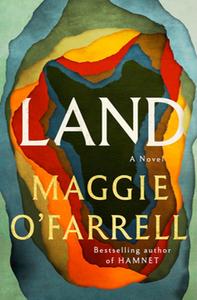
 The simplicity of its title masks the depth of insight and emotion that makes Maggie O'Farrell's novel Land such an encompassing reading experience. This story of a humble 19th-century Irish family is both a microcosm of the country's travails and a timeless exploration of themes of love, abandonment, loss, and grief.
Opening in 1865, a little more than a decade after the end of the Great Hunger, Land focuses on the family of Tomás, a surveyor and skilled cartographer who supports his family on commissions from the despised "scarlet-jacketed soldiers" engaged in a massive mapping project of his native land in the wake of the potato famine. To Tomás, they merely represent yet another in the "wave upon wave of conquerors, those who seek to occupy and enslave" the Irish people in their long, sad history. While the British "prefer never to acknowledge the crisis that befell the country," Tomás is determined that his maps "will bear an account of what happened, what was lost, if it kills him."
In the midst of one of his expeditions, he experiences a shattering trancelike state after drinking from an ancient spring--"a place of water at the base of the mountain that was sacred and inhabited by spirits." When he recovers, he uproots his family--mapmaking assistant son Liam, wife Phina, daughters Enda and Rose, and soon-to-be-born son Eugene--from their Dublin home and resettles them on the remote peninsula that transformed him.
Over the next two decades, as they pursue their outwardly simple existence, there are deaths and departures--Liam first to Rome and then India as a Jesuit priest, and Enda, a headstrong, talented fiddle player, to Canada--amid moments of tenderness and violence. Narrating these events, O'Farrell shifts effortlessly from one character's consciousness to another's, imbuing each with a distinctive emotional life and interior voice while assiduously avoiding tipping the scales of sympathy in favor of or against any one.
O'Farrell (The Marriage Portrait) enhances the deeply appealing family story at the novel's center by firmly maintaining its connection to the physical world. One especially lovely section elides, in fewer than 30 captivating pages, the numberless generations of human existence that preceded Tomás at the site of his mystical encounter, braiding enchanting descriptions of the natural environment with the stories of characters--most notably a girl named Brith--lost in the mists of history.
In Land, Maggie O'Farrell is engaged in the literary equivalent of Tomás's meticulous mapmaking. She's chosen to record her representation of Irish life on a much larger canvas than she did the world of William Shakespeare in Hamnet, but the same qualities of empathy and grace she displayed in that beautiful novel reappear here in abundance. --Harvey Freedenberg, freelance reviewer
Shelf Talker: Maggie O'Farrell illuminates the lives of a humble Irish family in the decades following the end of the Great Hunger.