

Rodolfo F. Acuña, founder of one of the first and largest Chicano studies programs at an American university and the author of a pioneering history of Mexican Americans, "who was known nearly as much for his gusto for political confrontation as for his scholarship," died on March 23, the New York Times reported. He was 93.
 |
|
|
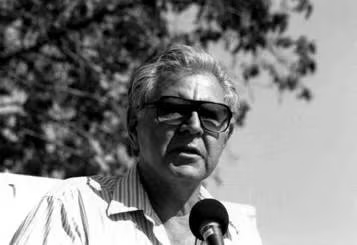
Rodolfo F. Acuña |
|
Born in East Los Angeles to Mexican immigrant parents, Acuña earned a Ph.D. in Latin American history from the University of Southern California in 1968. The Times noted that his consciousness about his heritage and activism "were shaped by the 1960s civil rights movements, especially the drive by Chicanos for cultural and political power in the American Southwest."
He was hired by San Fernando Valley State College (now California State University, Northridge) in Los Angeles in 1969 as its first professor of Mexican American studies, at a time when more Latino students were entering higher education.
His book Occupied America: A History of Chicanos (1972) "is a foundational text of Chicano studies that is still in print and still assigned to students. Its controversial thesis is that people of Mexican origin in the American Southwest remain subject to 'internal colonialism' more than a century and a half after the United States seized California and other territory from Mexico," the Times wrote.
"I contend that Mexicans in the United States are still a colonized people, but now the colonization is internal--it is occurring within the country rather than being imposed by an external power," Acuña observed in the book.
Historian Ramón Eduardo Ruiz, the author of 15 books on Mexico and Latin America, credited Acuña with "opening the national debate on the Chicano experience."
"I don't consider myself an intellectual," Acuña told an interviewer in 2014. "When I received my Ph.D., my father asked me, 'Si eres doctor, que curas?' 'If you are a doctor, what do you cure?' My strategy has always been to take my cause of the moment to the edge of the cliff and be prepared to go over the cliff if necessary."
His other books include Anything but Mexican: Chicanos in Contemporary Los Angeles (1996) and Corridors of Migration: The Odyssey of Mexican Laborers, 1600-1933 (2007).
Acuña's writing and teaching were sometimes a target of political conservatives. The Times noted that in 2012, public schools in Tucson, Ariz., removed Occupied America and other Chicano studies titles from classrooms "under a state law aimed at shutting down Mexican American curriculums. Conservatives said the books fostered resentment of white people."
Students and parents in Tucson protested, and in 2017, a federal court ruled the state had passed the law with racist intent. After further years of litigation, the same court, in 2025, overturned Arizona's ban on ethnic studies.