

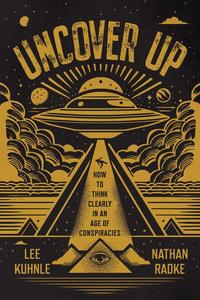
 Ever since humans began living in groups, conspiracy theories have been a fact of social life, but since the rise of the Internet and the birth of social media, it's become nearly impossible to quiet their din. The phenomenon cries out for thoughtful study, and that's precisely what Canadian academics Lee Kuhnle and Nathan Radke deliver in Uncover Up, a comprehensive examination of conspiracy theories: what they are and are not, how they arise and spread, and the habits of mind necessary to understand and combat them.
Drawing upon a variety of disciplines and sources that include social psychology, theories of group dynamics, and biblical philosophy, Kuhnle and Radke organize each chapter around a relevant concept from the world of conspiracy theories--such as how a binary worldview of good versus evil flattens one's perception of real world events or the powerful role community plays in shaping beliefs. They proceed to illustrate each concept through in-depth explorations of the elements of one or more conspiracies. They dive into the world of QAnon to highlight the pitfalls of a Manichaean perspective and present the antivaccination movement as an example of community-driven conspiratorial thinking.
Though these two conspiracy theories are associated with the right wing in contemporary U.S. politics, Uncover Up isn't a tendentious work and its insights are applicable across historical epochs and in differing social milieus. Kuhnle and Radke explain, for instance, how the 17th-century Salem witch trials provide a helpful framework for understanding Joseph McCarthy and the Red Scare of the 1950s. The authors also reveal the philosophical and historical roots in the book of Revelation for millenarian cults like Heaven's Gate, whose 39 members died by mass suicide in 1997.
Despite their scholarly credentials, Uncover Up's authors have tailored their work for general readers and for the most part avoid the pitfalls of academic jargon in elucidating their ideas. As one would expect, the book contains copious endnotes but would have benefited from a list of materials for further reading.
If Uncover Up merely provided a taxonomy of conspiracy theories and described how they flourish, it would be a worthwhile effort, but Kuhnle and Radke are intent on showing how even highly intelligent people can tumble into the trap of conspiratorial thinking, especially under the influence of social media and other online sources. They arm their readers with an ample collection of cautionary tales and a versatile tool kit for recognizing and avoiding the psychological shortcuts and environmental factors that lure some into those traps. Anyone who reads this useful book will be operating from a base of well-grounded skepticism when the next conspiracy theory bursts into the headlines. --Harvey Freedenberg, freelance reviewer
Shelf Talker: Two Canadian academics take a comprehensive look into the world of conspiracy theories, offering helpful tools for identifying them and avoiding their seductive lure.