

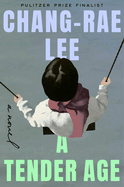
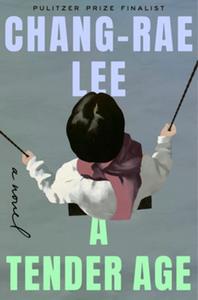
 Five years after his last novel, Chang-rae Lee (On Such a Full Sea) delivers A Tender Age, a luminous bildungsroman about the ache to belong. Jeon-Gi, an empty nester with his wife and canine, finds himself "suddenly thinking about the circumstances of how our girls got our dog." Years ago, they were visiting family friends and left with a three-month-old puppy that was being abused by the family's young son. In imagining the dog's revenge on his tormentor, Jeon-Gi insists, "To dispirit a certain kind you must be malign, become as bent as your nemesis. You must shock even yourself."
From there, the narrative explores "some rough times... [that] spanned the near-year that led up to my eleventh birthday during camp in the summer of 1976, a time when I was still a mere boy and had no yearnings to grow up or know anything more." Jeon-Gi, his younger sister, Ella, and their Korean parents live 35 minutes north of New York City in "a town that was much darker-skinned and poorer than the surrounding villages and hamlets, which were and still are mostly white and wealthy." Their apartment complex is home to "legions of us new immigrants," creating a diverse community "before diverse was an operative notion." The children regularly congregate outside to play: "we were young enough--we ranged in age from eight to twelve--that the bonds felt fierce, like in a tribe." But Jeon-Gi, his name sounding too close to "chunky," is bullied by an 11-year-old girl who weaponizes his devotion to his mother; he is also provoked by a racist playmate, then relentlessly terrorized by a fellow student. Even at summer camp, Jeon-Gi can't escape being targeted: "Was there some quality I possessed that inspired kids like Kathy Croker and Joshua Messing and Tommy Reilly and an otherwise impressive Korean camper to become my tormentors, my mistreaters?" Despite good friendships and supportive counselors, amid developing his first romantic feelings, that summer Jeon-Gi's increasingly uncontainable frustration pushes toward inevitable results that reverberate through lifetimes.
Lee again explores identity and acceptance, family and relationships, racism and privilege with raw intensity and biting insight, managing to write breathtaking prose through predictable mundanity but also wrenching inhumanity. He gorgeously, empathically captures Jeon-Gi's visceral struggles as he's caught between being othered and part of "the gang" while desperately navigating between childhood innocence and "confronting adult realities." In his masterful almost-ending, Lee shrouds what exactly happened on that life-altering precipice, brilliantly inviting room for interrogation and interpretation. --Terry Hong
Shelf Talker: Chang-rae Lee dazzlingly explores a young boy's childhood amid racism, bullying, and life-altering violence.