

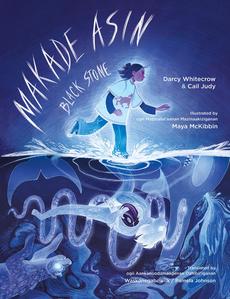
 Darcy Whitecrow (Across the Ice) and comics author Cail Judy's Makade Asin/Black Stone is a striking and contemplative dual-language picture book based on a traditional Indigenous story. The work opens with a question: "When you are full of fear... how do you stop being afraid?" This query immediately situates readers within an emotional and philosophical framework that is effectively direct. The abstract tone, though, may require a moment of adjustment for younger audiences before the narrative's action begins.
An unnamed Indigenous child, depicted near a shadowy figure, seeks guidance from an elder, who instructs them to find a mysterious black stone that will lessen the hold of fear. The child embarks on a perilous trek through various landscapes: thick jungle, rushing waters, and quicksand. The episodic structure emphasizes moments of confrontation and self-realization as the child faces each challenge with increasing resolve. For example, the child dissipates tension in a meeting with a large cheetah by meeting its gaze, transforming fear into connection.
The full-bleed digital illustrations from Maya McKibbin (The Song That Called Them Home, with David A. Robertson) make powerful use of every inch of the page, even adding panels atop areas of blank space. Swirling, kinetic lines and jagged forms heighten the sense of danger and urgency, and contrasting colors distinguish emotional states. The spirit-like figure associated with the child's fear appears in a cooler palette with an outline of diffuse silver; the child is rendered in saturated greens and copper tones. The imagery is dense and immersive, reinforcing the intensity of the youth's experiences.
The bilingual presentation, with text in both Anishinaabemowin and English (translated by Pamela Johnson), adds an important cultural dimension. The narrative underscores themes of inner strength, cultural continuity, and self-discovery: "Look within," the child hears in the desert. "What do you see?" The conclusion remains deliberately open-ended. The elder's request--"Tell me how you faced your fears"--invites reflection rather than providing a fixed interpretation. Readers are given space to consider their own answers since the child's experiences are not neatly summarized. A closing note from Whitecrow states, "In my culture, vision quests are an important part of finding your path." Readers of any age--especially those with an appreciation for Daniel Nayeri and Matt Rockefeller's Drawn Onward--may leave Makade Asin/Black Stone with a feeling of strength, courage, solemnity, and creativity. --Julie Danielson
Shelf Talker: Makade Asin/Black Stone, a culturally grounded picture book about fear and self-discovery, invites readers to confront the unknown.