

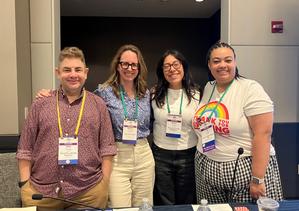
One of the early sessions at Children's Institute, "Making Children's Booksellers Out of Everyone," was especially popular, with more than 50 booksellers in attendance. The session--with panelists Rafe Posey of Third Place Books Ravenna, Seattle, Wash., Melissa LaSalle (aka @TheBookMommy) from Old Town Books, Alexandria, Va., Nahin Cano of Seminary Co-Op Bookstore, Chicago, Ill., and Lily Clay from Eagle Harbor Book Company, Bainbridge Island, Wash.--began with a tightly organized PowerPoint presentation, and was followed by an extensive q&a that made for a productive conversation.
 |
|
|
Panelists Rafe Posey, Melissa LaSalle, Nahin Cano, and Lily Clay |
|
The wide-ranging discussion covered the importance of being a generalist; building lifetime readers; shelf organization strategies; customer guidance; training practices; and general tips for making the store staff as strong as it possibly can be. LaSalle identified a motivating theme succinctly: "These are serious times. Kids don't want to read, and they don't value it." Stores that equip all booksellers to sell effectively in the children's section will help to build loyal lifetime readers, and that is crucial to the future of bookselling and our country in general."
One of the objectives of the session was to impress upon attendees the importance of making all booksellers in the store generalists--equally willing and able to sell adult titles and books in the children's section. As Posey pointed out: "They're all books, they're all stories, and we should be involved in all of them." The panelists acknowledged that much of what they presented in their deck amounts to "forcing" booksellers to learn titles, authors, and strategies that are outside of their comfort zone, but they presented it as encouraging employees to be better booksellers overall.
The panelists shared training tips that could be implemented by independent bookstores of any size. Clay gives new booksellers a written scavenger hunt that asks them to come up with three books from the shelves that address imaginary (but realistic) customer requests (new booksellers beware: ex-teacher Clay is a tough grader). Cano does a similar exercise, using her morning book talk to describe a customer request, and then dispatching booksellers on a hunt throughout the store. LaSalle offers a role-playing scenario--she writes lines for an imaginary customer, and then calls out two booksellers during a staff meeting. One has to role-play the customer, and the other, a new bookseller, has to address their requests. When booksellers role-play around actual customer concerns and questions, LaSalle said, it increases bookseller recall of titles and authors. This last point led to the group advising booksellers develop a "back pocket list" of potential titles for different categories.
The panelists discussed shelving strategies, with LaSalle and Posey in particular encouraging new thinking. Third Place Ravenna has integrated all categories in feature displays, and Old Town has moved to genre-based shelving--e.g., YA Fantasy vs MG Fantasy; Real World Drama; Make Me Laugh; Animal Stories, etc. This change, LaSalle said, has led to a "30% growth in sales in young teen since we implemented it." The panelists noted that it is easy to adjust the recorded categories for these titles in both Bookmanager and Booklog.
In the q&a, the conversation touched on customer interactions and how to turn a difficult conversation (one example: "he can have any book, but not a graphic novel") into a positive experience for guardian, bookseller, and reader alike. There was extended discussion about how to handle requests for books by J.K .Rowling, with a variety of solutions. Shifting attention to other series, such as Nevermoor and Dragonborn, has proven successful, but there are no easy answers. One bookseller offered that they have a separate category for Rowling sales, and donate profits at the end of each month to a trans-supportive organization.
Among the useful and specific tips that came up throughout the session:
- When making recommendations for a child/parent, build a stack of titles, which gives the customer permission to "reject" titles. This also creates opportunity for discovery and multiple title purchase. A stack also gives the bookseller one-on-one time with the parent, which helps to build loyalty. This kind of engagement can be a time to explain advanced concepts to a reluctant parent (e.g., how re-reading a graphic novel builds reading stamina and comprehension).
- Talk to the child using open-ended questions. Be weird--kids love that, and it helps to create a connection.
- LaSalle uses Slack extensively, and keeps a detailed spreadsheet of upcoming titles that she encourages staff to read and rate. Not finishing a title is understood and allowed, and LaSalle tries to read everything that her staff liked.
- Posey uses e-mail to communicate with staff since they are rarely all together, and he does so frequently. All of the panelists endorsed the frequency of communications, and Cano offered that she puts hidden questions in her e-mails and requires staff to answer them.
- The panelists emphasized the importance of the buyer being on the sales floor. While many set aside time to work at home or in a back office, there is no substitute for being on the floor in order to understand the tenor and demands of the customer base. --Matt Baldacci, Shelf Awareness