

"You're losing your librarians every day," said Brein Lopez, general manager of Children's Book World in Los Angeles, Calif., during an education session Monday morning at Children's Institute 2026 in Schaumburg, Ill., about rebuilding school relationships without librarians.
 |
|
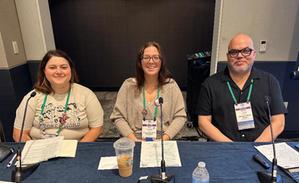
| Left to right: Bonnie Ingersoll, Allie Cesmat, Brein Lopez | |
On the panel with Lopez were Allie Cesmat, children's book buyer and department manager at Changing Hands Bookstore in Phoenix and Tempe, Ariz., and Bonnie Ingersoll, co-owner and operations manager of Spoke & Word Books in Milwaukie, Ore.
"It's only going to get worse going into the election season in the fall," Lopez continued. "Everybody needs to be prepared for what that means in your community."
Cesmat reported that she's seen school districts in the Phoenix area "cut all librarian positions as of this fall," while others have closed libraries on elementary school and junior high school campuses entirely, with many teachers suddenly having to "self-direct" a library experience on their own. Educators must also deal with a review period for any book going into a school, which gives 90 days for anyone, regardless of whether they even live in Arizona, to challenge the book.
Ingersoll, meanwhile, has seen the "elimination of certified librarians" from her school district. Librarians are being replaced with vaguely defined "media tech positions," and the people entering those roles seem to have "little to no" experience with or affinity for books.
A number of booksellers in attendance also shared what they've seen in their communities, with several saying that Moms for Liberty has effectively taken over their respective school boards. A bookseller from Wisconsin remarked that the money being spent on school board elections is "stunning," and a bookseller from Raleigh, N.C., said their school district has instituted a policy whereby principals have to sign off on every single book that enters their school, leaving librarians without the ability to add books to their own libraries.
Lopez highlighted the effect that ICE activity has had on school libraries. In the communities where ICE has been active, they have been going into schools, leading to some parents keeping their children at home out of fear for their safety. "The minute enrollment goes down," Lopez stressed, budgets are getting cut, and it's not the administrators' salaries that are being cut. It is "nurses, library techs, and librarians."
Without librarians to turn to, booksellers could make contacts with teachers, PTOs and PTAs, and school administrators. Lopez stressed the importance of making sure administrators are "100% on board" with a given author visit, book fair, or other school event, as there is "nothing worse" than doing all the necessary work only to have the event fall through at the last minute.
Cesmat mentioned working from the "district level down," and trying to get district support rather than individual school support, as well as talking to outgoing librarians about their replacements. Ingersoll said she's had success reaching out to public librarians as well as teachers' unions. They, along with PTOs and PTAs, are "really beneficial" for "infiltrating the system" and getting a foot in the door.
With booksellers unlikely to get the opportunity to go into schools themselves, Lopez said, it is important to "make these contacts in your actual bookstore." His store, for example, hosts free live music on Saturday mornings nearly every weekend of the year, and that serves as a great way to form relationships with parents and families. Having a "whole community of parents" supporting and believing in the bookstore can go a long way with swaying school administrators. This is especially true at private schools or in wealthy school districts.
Educator nights can serve as a good way of building relationships with teachers. One bookseller in attendance said they used to do their annual educator night in June, but this year are switching it to September, when teachers have a bit more energy. Another audience member said her store runs two educator nights per year, one in the fall and one in spring, with the fall night generally having better attendance, and those nights can include publisher reps telling teachers about upcoming books. Several booksellers mentioned saving up ARCs and publisher swag to give away to teachers during educator nights.
Ingersoll said she offers a 10% discount to all teachers and educators, and she often talks about "what's going on in schools" with customers at the register. Lopez offers educators a 10% discount on orders under $100 and 20% on orders over $100, if the books are being purchased for the school. He advised against giving parents similar discounts, and he noted that every year toward the end of the school year, districts and classrooms have money left over but are "too busy" with testing and other things to spend it. That money typically disappears if not spent, as it generally does not roll over into the new school year, and Lopez advised reaching out to school contacts after spring holidays to let them know "we're here for you."
Touching on classroom wishlists, Lopez said they can be a bit tricky with IndieCommerce 2.0, and most of the time, he creates the wish list for teachers and provides links that they can send along to parents. Ingersoll mentioned that Bookmanager has "very robust" registries and wish list features, and booksellers with other POS systems may have an easier time. The panelists agreed that when it comes to books for school visits or classroom wish lists, it is better to have the teachers or authors come pick them up.
On the subject of donating books to teachers and classrooms, Cesmat discussed her store's Books for Teachers program, which involves asking customers to round up purchase amounts at the register to buy books for teachers. It is not a nonprofit, and essentially functions as a gift card that the bookstore "reloads" with donations. In the first month of doing the program, the store raised some $3,000 for teachers.
Children's Book World has a literacy nonprofit called Readers and Writers Rock!, which was founded with the help of a James Patterson grant and is operated by the store's owner emeritus. Lopez described it as a "children's book recycling center," where community members donate books that are then given to foster programs, Title 1 schools, and teachers.
Ingersoll brought up capacity, emphasizing that indie booksellers all have different staffing levels and "can only do what we can do." If it is too much to start a nonprofit or donation program on their own, booksellers can look to partnering with the organizations in their communities already doing that work.
Lopez took a moment toward the end of the session to talk about the school visit experience, strongly encouraging any booksellers still allowing signings to happen in-person at schools to "stop it." No child, he said, should ever have an experience that is defined by their parents' ability to purchase them a book. Signed books should be delivered to classrooms after the event, and "the visit should be open and accessible to every single student." --Alex Mutter