

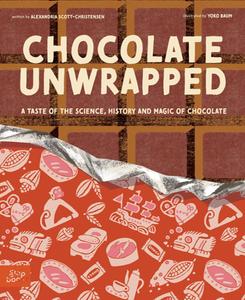
 Alexandria Scott-Christensen peels back the layers of cacao in her multifaceted debut picture book about chocolate, the "almost universally loved food." She takes young readers into the forests where cacao trees thrive, the factories where the fruit is processed, and across the continents and through history to show cacao's wide variety of purposes; she even propels readers into "the future of chocolate."
Chocolate Unwrapped is divided into several different sections, each displayed on an illustrated double-page spread. Main text gives readers an overview of the topic--"Anatomy of the Fruit," "Cacao's Home," or "Mesoamerican Origins"--while sidebars add delightful tidbits of information to the topic at hand. Readers can learn that "cacao pods grow directly on the tree's trunk or limbs," and that "it takes about 400 cocoa beans to make one pound of chocolate." Scott-Christensen describes chocolate's Mesoamerican origins and uses in medicine, currency, religious rituals, and more. She clearly explains how chocolate was colonized by Europeans; they conquered the peoples and land of Mesoamerica, used the fruit and forced labor to create massive wealth for themselves, and ultimately dedicated other colonized locations to continue growing cacao trees with forced labor. With the Industrial Revolution came improved processing for developing chocolate, making it cheaper and easier to produce and less of a luxury good. Scott-Christensen also discusses scientific elements of the beloved confection, describing how a chemical in chocolate makes "your brain release dopamine, which can make you feel happy" and that "cacao waste can be turned into biochar" (a substance "like charcoal, but better for the environment").
Yoko Baum (A Very Asian Guide to Japanese Food illustrator) uses an earth-toned palette for the book's digital illustrations, which work to encapsulate the various topics addressed on each page through inset bubbles, diagrams, and spot illustrations. To emphasize the layers of elements necessary for cacao trees to thrive, Baum even changes the illustrative format mid-book, requiring readers to turn their books--or heads--90 degrees. The lively art has a mostly two-dimensional feel, with human figures drawn in a naïve style.
Back matter includes a recipe for hot chocolate and an interview with "the first ever chocolate maker in Guinée, West Africa," Djenabou Diallo. Young chocolate afficionados will likely leave the pages of Chocolate Unwrapped with an appreciation for chocolate, its long history, and its potential future uses. --Jen Forbus, freelancer
Shelf Talker: Young readers can devour the history and science of cacao beans and their delicious product in this fact-filled, enlightening debut picture book.