

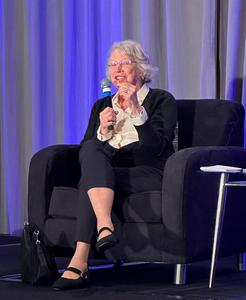
"That's what gives me hope--because out there is a generation of young people around the world that cares about the world," said Lois Lowry, Newbery Medal-winning author of The Giver and Number the Stars, during the closing keynote of Children's Institute 2026 in Schaumburg, Ill., Monday afternoon.
 |
|
| Lois Lowry | |
Lowry, whose new novel, Building 903, is due out from Clarion Books in September, was in conversation with Cathy Berner, children's & YA specialist at Blue Willow Bookshop in Houston, Tex. The pair discussed the origins of Building 903, Lowry's reasons for writing for young people, and the "dangerous work" of putting books in the hands of children.
Elaborating on feeling hopeful, Lowry said the "future right now is a very ambiguous thing," and there are so many liberties "we fear losing." But, ever since the pandemic, Lowry has been doing virtual classroom visits with teens all over the world, in places as diverse as Romania, South Korea, Japan, Turkey, and even Iran. The conversations are almost always about The Giver, and the big question that students keeping asking Lowry is: How can we keep this from happening? That shared concern, Lowry reiterated, is "what gives me hope."
Building 903, which marks a return for Lowry to the subject of a dystopian future, grew out of a short story she wrote for the children's magazine Kazoo. Each issue has a theme, and the theme for Lowry was future. What Lowry envisioned was a story featuring a seven-year-old girl, living in a time when books have largely disappeared. Lifespans are much longer, and when her 130-year-old neighbor is preparing to go to an assisted living facility, the neighbor gives the girl a key to a room full of books.
The story is brief and generally cheery, Lowry said, but the scenario of a "time when books have disappeared" stuck with her, and it began to seem like something "much more ominous." Set in 2099, Building 903 also features a world without books, but here they've been banned for decades by order of the totalitarian Leader. And in Building 903, the protagonist is a 14-year-old girl named Tessa, who is searching for her missing twin brother. When Tessa's elderly neighbor gives her a key to a room full of books, it opens up a world of both wonder and danger.
Berner mentioned that Building 903 features a character describing the experience of reading a book and the emotional, visceral reactions it can create. She asked Lowry what books have caused that sort of reaction for her; Lowry's answer was The Yearling by Marjorie Kinnan Rawlings, which her mother read to her when she was around nine years old. It was an adult book, Lowry pointed out, and full of things like racism and tragedy that were "supposed to be above the interest and intellect of an eight- or nine-year-old child."
Asked what made her decide to write books for young people, Lowry explained that she majored in writing, and when she began her writing career she wrote for adults, fully intending to one day write the "Great American Novel for adults." However, after she wrote a short story for adults that was told through the eyes of a child, an editor wrote to her asking if she would consider writing for kids. Lowry proceeded to write a book for children based on the death of her sister, A Summer to Die (1977), and she got such "passionate, heartbreaking letters" from young people that she decided "this was what I'm going to pursue."
The conversation concluded with Berner asking Lowry to read a portion of her 1994 Newbery Medal acceptance speech, which Lowry noted was addressed to librarians but equally pertained to booksellers.
Lowry read: "Let me say something to those of you here who do such dangerous work. The man that I named The Giver passed along to the boy knowledge, history, memories, color, pain, laughter, love, and truth. Every time you place a book in the hands of a child, you do the same thing. It is very risky. But each time a child opens a book, he pushes open the gate that separates him from Elsewhere. It gives him choices. It gives him freedom. Those are magnificent, wonderfully unsafe things." --Alex Mutter