

|
|
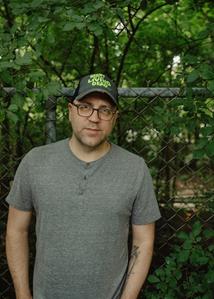
| photo: Lyndon French | |
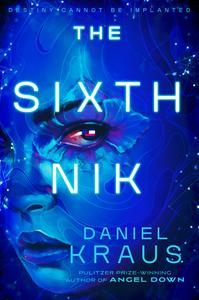
Chicago author Daniel Kraus won a Pulitzer Prize for Angel Down. His novel Whalefall received a front-cover review in the New York Times Book Review, won the Alex Award, was a Los Angeles Times Book Prize finalist, and was named a Best Book of 2023 by NPR, the New York Times, and the Chicago Tribune. With Guillermo del Toro, he coauthored The Shape of Water, based on the idea the two created for the Oscar-winning film. Also with del Toro, Kraus coauthored Trollhunters, which was adapted into the Emmy-winning Netflix series. He co-wrote The Living Dead and Pay the Piper with filmmaker George A. Romero. Kraus's The Death and Life of Zebulon Finch was one of Entertainment Weekly's Top 10 Books of the Year. Kraus has won the Bram Stoker Award, a Scribe Award, two Odyssey Awards (for Rotters and Scowler), and more. His latest novel, The Sixth Nik (Saga Press, June 23, 2026), is a galaxy-spanning adventure set aboard a ship woven from biomatter and capable of reacting to every need of its human crew.
Handsell readers your book:
I've made a nice, long career writing disturbing novels, but nothing I've ever written touches The Sixth Nik. This is me at my most unchained and deranged--but hopefully, emotionally, and intellectually challenging too. It's about a nine-year-old cultist who is raised to be brilliant for roughly three years before the tech in her brain drives her insane. She is assigned the task of boarding a ship made of living tissue to discover the fate of a colony of plague-ridden spacefarers. It is absolutely bonkers.
On your nightstand now:
Gettysburg by Stephen W. Sears. My comfort spot in literature right now is anything about the U.S. Civil War, not only because every single leader endlessly fascinates me, but because, as you might expect, all those reads are leading toward a work of my own that I've planning for many, many years. I've read Gettysburg books before, but not this one, which many say is a modern classic. So far, so good.
Favorite book when you were a child:
No single book stands out from pre-middle school, so I think I'll go with Richard Adams's Watership Down. It blew my mind the way that Tolkien books were no doubt blowing the minds of other kids my age. I rarely read books more than once, but I've read this several times, and eventually did my own homage called the Teddies Saga.
 Your top five authors:
This question is cruel and unusual, and so my answer will be slapdash and flawed. I suppose, just for today, I'll go with Jonathan Eig, Shelby Foote, Junji Ito, Kathe Koja, and Maryse Meijer.
Book you've faked reading:
While I can't recall ever doing this specifically, I assume I have faked knowing more about the works of Homer than I really do.
Book you're an evangelist for:
One Hand to Hold, One Hand to Carve by M. Shaw. Genius.
Book you've bought for the cover:
Toad by Katherine Dunn. Good book, too.
Book you hid from your parents:
Naked Lunch by William S. Burroughs. My mom actually bought it for me at my request, but neither of us had any idea what was inside.
Book that changed your life:
Danse Macabre by Stephen King. It was my pre-Internet Internet; it described media beyond my wildest dreams that was all the more tantalizing because I couldn't actually see, read, or listen to hardly any of it. It got my brain spinning, and it's never stopped.
Favorite line from a book:
"My tale was not one to announce publicly; its astonishing horror would be looked upon as madness by the vulgar." This is a quote from Mary Shelley's Frankenstein, and I used it at the front of my book Rotters.
Five books you'll never part with:
Since I can always rebuy books, I interpret this question as asking about specific copies of books that for various reasons mean something to me. To that end, I will choose my beat-up copies of Clive Barker's Weaveworld, Peter Straub's Ghost Story, Grace Metalious's Peyton Place, Ralph Ellison's Invisible Man, and Ray Bradbury's The Martian Chronicles.
Book you most want to read again for the first time:
Childhood's End by Arthur C. Clarke. I swear, it taught me how to plot.