

 "To imagine my great-grandmother seeing where we still are now breaks my heart. But at the same time, this is also a monster we've fought," said Celeste Headlee, author of Freedom's Daughters: How a Generation of Black Women Resisted Oppression Through Literacy and Education (Flatiron Books, Oct.), during the opening breakfast at New Voices New Rooms 2026 in Baltimore, Md., Monday morning.
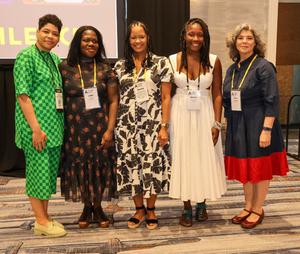
The keynote, entitled "We Will Not Be Silenced: Black Women Shaping Our Narrative," featured Headlee; Afia Atakora, author of Strivers (Random House, Feb. 2027); Nicole Dennis-Benn, author of Black Gold (Random House, Jan. 2027); and Soyica Diggs Colbert, author of Freedom's Gate: Maya Angelou, Lorraine Hansberry, Abbey Lincoln, Miriam Makeba, and Nina Simone Live at the New York Nightclub that Shaped the Civil Rights Movement (W.W. Norton, Oct.). Hannah Oliver Depp, owner of Loyalty Bookstores, Washington, D.C., moderated the discussion.
 |
|
| From left: moderator Hannah Oliver Depp, with authors Afia Atakora, Soyica Diggs Colbert, Nicole Dennis-Benn, and Celeste Headlee. (photo: SP Rankin) | |
"We actually know how to fight this and we have won some of these battles," continued Headlee, whose book is about the largely forgotten generation of Black women who lived during Reconstruction and built schools, created health-care clinics, and grappled with the question of what it really means to be free. She was inspired to write the book because her great-grandfather, one of the first African American classical composers in the U.S., credited his success to his own mother, one of the women of Reconstruction. "It's not like we don't know how to do this. It's not like we don't recognize this monster. We know who this is and we can look back to our ancestors and say okay, how do we do this."
Atakora described her novel Strivers as a Great Gatsby-esque murder mystery set during the Harlem Renaissance. It tells the story of Nadine, a queer woman and a reluctant member of Harlem's Black elite, who rebels against expectations and decides to open her own speakeasy. But on the speakeasy's opening night, she finds her lover dead on the doorstep, and she makes the impulsive decision to hide the body.
In the 1920s, noted Atakora, the Great Migration was taking place, and in Harlem different strata of Black society were coming together and mixing. There were Black millionaires whose families had been in Harlem for generations, along with immigrants from the Caribbean as well as people moving from the South, and there was a question of "what it is to be Black in public." She was interested in the question of identity and assimilation, and the fact that during that era being on stage offered an outlet, especially to Black women, where they could be "strange, you could be profane, you could be surprising, to a point."
Faye, the main character of Black Gold, is a descendant of the Maroons, a community of former slaves who lived in Jamaica's Blue Mountains and were the first in the country's history to win their freedom, explained Dennis-Benn. When Faye's mother is forced to sell the family's home in the Blue Mountains after falling ill, Faye turns to modeling to help her family and support her own independence. Along the way, Faye tries to carve her own path while learning more about the complicated history of her own family and of the Maroons.
A major question explored in the novel is that of "myth versus history" and the liberation that occurs when people "willingly face the facts" and don't turn away from history. Remarking that the Maroons are "sacred" in Jamaica, Dennis-Benn said she "froze a little bit" when she first started writing the novel. She was concerned, among other things, that the inclusion of queer women in the story of the Maroons would be controversial but, she said, "we have existed, we've always existed as queer women," and she had to push forward. The best advice she got, Dennis-Benn continued, was to put the research to the side "and just write."
Diggs Colbert called Freedom's Gate "part group biography, part story of a place," with the place being a nightclub called the Village Gate that once operated on Bleecker St. in New York City, and the group being the Black women who congregated and performed there that included Maya Angelou, Nina Simone, Lorraine Hansbury, Miriam Makeba, and Abbey Lincoln. There, these young women "gathered, plotted and planned" and "incubated their political selves" before becoming the stars people know them as today.
When people ask her if the Village Gate was a Black club, Diggs Colbert said, she usually responds by saying "it was a Black club when they were there." Part of the book's thesis, she said, is that "places are not static," and they become what they are because of the people in them. She said she also tries to puncture the idea that fame and success meant these women had to be alone and apart. While they did struggle with loneliness at times, they were also "surrounded by people who supported them." They relied on a "whole cadre" of people, and that community was a key part of what made them great. --Alex Mutter