

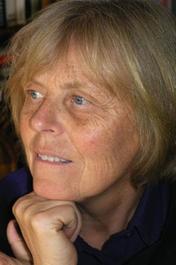
Ursula Hegi, "a novelist who drew on her childhood in post-World War II Germany to write searing books about silence, community, and historical memory," including the bestselling Stones from the River, died on July 27, the New York Times reported. She was 80. Born in the western half of occupied Germany just after WWII, she immigrated to the U.S. after high school and became an American citizen, though her native country served as the wellspring for much of her writing.
 |
|
| Ursula Hego (photo: Gordon Gagliano) |
|
She was best known for a cycle of four novels, set during the first half of the 20th century, that take place in the fictional German town of Burgdorf. Beginning with Floating in My Mother's Palm (1990), the quartet explored the ways in which the people of the town both acknowledge and ignore the dark passage of history around them. Burgdorf, she wrote, was the sort of provincial locale where life "happened slower and later than in most other places."
"Hegi's genius lies in her ability to recreate the Nazi era without ever calling up its nomenclature," Barbara Finkelstein wrote in a Chicago Tribune review. "There is not a word in here about gas chambers, Gestapo agents or Jews."
Hegi's second Burgdorf novel, Stones from the River (1994), launched with a modest original print run of 25,000, but in 1997 Oprah Winfrey chose it for her year-old Oprah's Book Club, driving the book onto bestseller lists and prompting the publisher to print 1.5 million hardcover copies and 500,000 paperbacks. The other books in the Burgdorf Cycle are The Vision of Emma Blau and Children and Fire.
Stones from the River revolves around Trudi Montag, a dwarf who is "both an outcast and a fixture of town life, an indispensable gossip and fixer," the Times noted, adding: "In Ms. Hegi's hands, Trudi becomes a sharp lens for examining the ways in which Burgdorf--and Germany writ large--responds to the Nazi era."
Hegi contended she did not set out to write books of politics or ideas, describing such an approach as propaganda, not literature. "We can't have the fiction be a mouthpiece for our ideas," she told the journal Focus on Literatur (now Focus on German Studies) in 1996. "If I really want to make a point--if I want to write about an idea--I do that in nonfiction and I come straight forward and say it."
In addition to her nine novels, Hegi wrote two books of short stories, a children's book, and a nonfiction work, Tearing the Silence: On Being German in America (1997), for which she interviewed hundreds of German Americans who had been born around the Nazi era, as she had.
Her honors include the Italian Grinzane Cavour prize for best foreign fiction, an NEA Fellowship, and a PEN/Faulkner Award, along with five PEN Syndicated Fiction Awards. She served as a juror for both the National Book Award and the National Book Critics Circle, and taught writing at institutions including Stony Brook Southampton, Barnard College, the University of California at Irvine, and Bread Loaf, as well as Eastern Washington University earlier in her career.
In interviews, she spoke "about the extensive historical research she did for each novel, building what she called the scaffolding of her literary world. But she emphasized the importance of turning that research into compelling prose," the Times noted.
"If you want to look at fiction as the building, I had the building but I also had the scaffolding that helped me to build this building," she told Focus on Literatur. "And if we were to leave the scaffolding on the building it would be very ugly. So it was a real challenge and took a lot of revisions to massage the research into the text."