

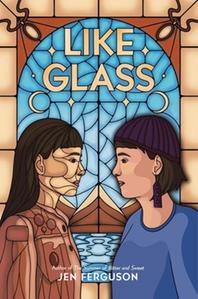
 Like Glass, by YA author and William C. Morris and Stonewall Award Honor winner Jen Ferguson (The Summer of Bitter and Sweet; A Constellation of Minor Bears), paints a poignant portrait of grief through a Métis teen's captivating and chaotic determination to understand her sister's death and why her father refuses to leave the place where it happened.
One year ago, Tate's older sister, Bronwyn, died of an aneurysm while living in a small town in the French Alps. Tate's Métis father and "white settler" mother left Toronto to bring Bronwyn's body home, but only Tate's mother came back. Now, the 16-year-old Métis teen arrives in Chamonix with one goal: convincing her father to leave this snowy place. Tate can't imagine her sister having lived there at all: "Either she was following a bad thing or running from one." As she endeavors to figure out what Bronwyn was doing in Chamonix, she meets queer American ski jump athlete Agatha, who is trying to qualify for the Olympics. Agatha makes Tate's heart beat like "a drum in a circle of other drums" and she seems to "get" the grieving teen. Meanwhile, Tate worries she will have no purpose once she has uncovered every mystery about her sister, and she flounders under the feeling that she's "misplaced" herself.
Ferguson precisely encapsulates the desolation of a tragic loss and the desperation to understand it. There is no fantasy here, but there is a familiar and near-mystic entropy in the foreboding undercurrent that Tate feels among the people who knew her sister and the places where she lived and died. Tate's attempt to exist in Chamonix, where everyone who looks at her sees Bronwyn first, eloquently portrays how one sibling can be measured by another: "In French, limes are called green lemons... defined not by what they are, but what they are like... I don't know what limes would do, in French, if lemons went extinct." Ferguson also adroitly depicts an eggshell-lined path to mending between an imperfect yet loving father and the only daughter he has left. She seamlessly folds racism into Tate's interactions with locals ("Are you of the full blood, ja, or like us, appreciative of their unique, primitive culture?") and plants a satisfying queer romance in stuck elevators, heart-stopping break-in missions, and a stealth road trip. Tate, who cuts the collars from her shirts, isn't a hugger, and tends to overexplain, is a fully realized teen who acknowledges that "personhood is hard" in this deeply felt YA novel about sorrow and reconciliation. --Samantha Zaboski, freelance editor and reviewer
Shelf Talker: A Métis teen travels to the town where her sister died and where her father now lives to understand them both in this genuine and chaotically adventurous YA exploration of grief and personhood.