

 |
|
| Wendell Berry | |
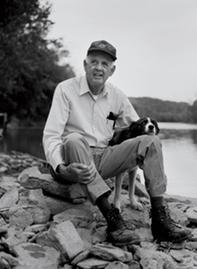
Wendell Berry, a Kentucky farmer "who plowed his fields behind Belgian draft horses and wrote lyrical poems, novels, and essays--mostly in pencil and without electric light--that explored his elegiac visions of the life and death of agrarian America," died August 31, the New York Times reported. He was 92. Berry wrote more than 50 volumes of poetry, fiction, and nonfiction that championed small family farms, the environment, local foods, and interdependent communities.
"Wendell Berry has passed. Another great light gone out," Kentucky-born author Silas House posted on Facebook: "There are so many ways he influenced me but most of all what I keep thinking is that he was so good to me. Generous with his time and words. Complex. Brilliant. Revolutionary. Here's my favorite picture of him. In his socks out on the porch at Port Royal, laughing and telling a tale, with a dog nearby.... I’m sending big waves of love to Tanya and the entire Berry family, all of them so good, like him."
Raised on a farm in north-central Kentucky, Berry studied English at the University of Kentucky, then writing at Stanford University with Wallace Stegner. He traveled in Italy before ending up in New York, where he intended to write and teach. He married, had two children, and taught for two years at New York University. At 30, however, "he confronted in himself a deep need to return to his roots--specifically, to an old two-room cabin on the Kentucky River at Port Royal, in Henry County, where his ancestors had lived since 1803. The cabin had been built in the 1920s by a great-uncle. He had known the place all his life; indeed, had visited it often as a boy and spent a summer there with his wife, Tanya." the Times wrote.
"In the life we lived that summer, we represented to ourselves what we wanted--and it was not the headlong pilgrimage after money and comfort and prestige," he recalled in his essay "The Long-Legged House." In 1964, they bought a 125-acre farm, called Lanes Landing, and started raising sheep, corn and grain crops, along gardens for their own table. Berry also taught for 20 years at the University of Kentucky, in Lexington.
Regarding his decision to return home to write for the rest of his life, Berry recalled: "It made a permanent connection between me and my native place, and with its landscape. The landscape was there to check me if I was wrong. I could never go away and make up stuff at cocktail parties about the backwoods of Kentucky. I worked with people here in all walks of life and learned from them. It's been a very rich experience."
His first major book was The Unsettling of America: Culture & Agriculture (1977), a manifesto to save small farms from big business and a government bent on agricultural efficiencies that, he said, were destroying the land and a way of life. The book launched the modern movement for sustainable farming and became a conservationist classic, the Times noted.
In a Times review, farmer-poet Donald Hall praised the book's "worldview that derives its premises from the experience of working on the land. [Berry] argues with careful logic for the recovery of lost land, for the return of the small farmer to the countryside, the small farmer expropriated by the army of agribusiness."
Berry's essay collections The Gift of Good Land (1981) and Home Economics (1987) continued the theme as did his fiction--more than a dozen novels and volumes of short stories. "He invented a town, Port William, Ky., as a setting for generations of lives interwoven in tales of murder, alcoholism, marital discord and remembrance against subtexts of fading agrarian life," the Times wrote.
Berry's novels include Nathan Coulter (1960), A Place on Earth (1967), The Memory of Old Jack (1974), Jayber Crow (2000), Hannah Coulter (2004), and Andy Catlett: Early Travels (2006). In 2018, the Library of America published Wendell Berry: Port William Novels & Stories (The Civil War to World War II), which was followed in 2019 by the two-volume What I Stand On: The Collected Essays of Wendell Berry 1969–2017.
Among his many poetry collections are This Day: Collected & New Sabbath Poems (2014), Given (2005), A Timbered Choir: The Sabbath Poems 1979-1997 (1999), The Selected Poems of Wendell Berry (1988), Collected Poems 1957-1982 (1985), Clearing (1977), and The Broken Ground (1964).
From Berry's poem "Before Dark":
From the porch at dusk I watched
a kingfisher wild in flight
he could only have made for joy....
The splashes went on out of hearing.
It was dark then. Somewhere
the night had accommodated him
--at the place he was headed for
or where, led by his delight,
he came.