

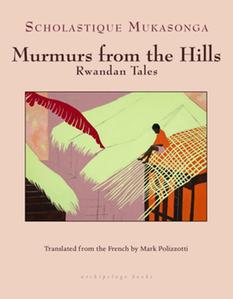
 In fiction and memoirs, Scholastique Mukasonga, an internationally renowned Rwandan writer living in France, has extraordinarily memorialized her horrific family tragedy during the 1994 Tutsi genocide, when 37 family members--including her mother--were massacred. In Murmurs from the Hills: Rwandan Tales, which reunites her with lauded author/translator Mark Polizzotti for a third collaboration (after Kibogo and Sister Deborah), Mukasonga pivots from that specific violence to entwine personal experiences and mythical events into six exceptional short stories.
The first-person narrator of the opening story, "The Rukarara," is named Scholastique Mukasonga, and her mother is Stefania, which is also Mukasonga's late mother's name. The story is filled with autobiographical details--Scholastique's birth "on the banks of the Rukarara," her family's removal from their native village, their years as "internal refugees," her struggles as an adult to return home, writing her novel Our Lady of the Nile. Into that intimacy, she then interlaces the journey of German explorer Dr. Richard Kandt (born Kantorowicz), notable for reaching the source of the Rukarara and declaring it to be the source of the Nile in 1898, as part of the colonial legacy he left behind.
In "The Wood of the Cross," a Rwandan sociology student writes a story for a white lover that he'll "likely never read," revealing the provenance of what he dismissively calls her "juju"--a pendant of sacred wood worn around her waist, bestowed by her mother. "Titicarabi" involves an enchantingly loquacious talking dog "in another Africa that was not Rwanda," a French song title, and a son's unwanted, discarded nickname. A schoolgirl finally hears the whole story, in "King Musinga's Cow," of how her grandfather was given a royal cow from the titular king, who resisted and was subsequently dethroned by the colonial Belgian administration. In "Misfortune," a small town blames all their calamities and catastrophes on a single woman, who was named "She-of-misfortune" by her own father because she was not born a boy. "Cyprien the Mutwa," about the young community outcast, gets a thoroughly satisfying resolution in the last paragraph.
As she always has, Mukasonga writes clearly and affectingly of difficult history, deftly inserting--without didactic pronouncements--references to German colonialism, Belgian domination, forced Christian catechism, racial segregation, and fatal bloodshed. Remarkable, too, is her seamless ability to integrate gentle levity and surprising humor. Expressive, startling, poignant, Mukasonga's stories capture a Rwanda long vanished, superbly recorded to enjoy in perpetuity. --Terry Hong
Shelf Talker: Scholastique Mukasonga's Murmurs from the Hills features six exceptional stories that together create a remarkable mosaic of Rwanda's difficult history.