

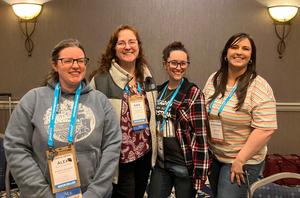
Alex Schaffner of Brookline Booksmith in Brookline, Mass., moderated the "Every Event Is a Special Event" panel, featuring Kate Keisling, owner of The Purple Couch Bookshop, North Andover, Mass.; Ryan Clark, manager of events and marketing, Gibson's Bookstore, Concord, N.H.; and Stephanie Pando, senior publicist, Abrams Books. Schaffner guided the conversation through the process of planning an event and working it, with a focus on ways bookstores can pair with publicists and publishers.
 |
|
| From left: Alex Schaffner, Kate Keisling, Ryan Clark, Stephanie Pando | |
Clark and Keisling started out by describing what they consider to be a special event. "Obviously," said Clark, "butts in seats makes me feel good. Books sold makes me feel good. But mostly, I want my author to be happy." Her approach is to treat "every event like it's a big event." Keisling agreed, adding that an event is successful to her if the attendees felt comfortable and left "wanting to come back."
Once the event has been planned, organization is key. Clark said, "Author care is something we talk about ahead of time: giving them a point person, spending time with them, making them feel special. I like to give my authors a heads up on attendance, whether high or low, to set a reasonable expectation." This, Pando said, can be very helpful because no matter the size of the crowd, the publicist can remind the author they are "going there to build relationships with the bookstores and booksellers who will, in turn, remember them and sell their books."
What should stores do to prep for events? "I have a basket of ARCs behind the register by the authors coming for events and encourage my staff to read them," Clark said. "We make a trifold flyer for customers that has all the month's events, as well as simple bookmarks with book cover, author name, and when they're coming. I communicate with the authors and the publicist and, if I notice an event is getting less people than anticipated, I'll reach out to the publicist to ask them to push the publicity." Schaffner added that anyone coordinating an event should remember to "standardize the information you're sending out to customers, publishers, and authors. If you don't have a set list that you're sending out every time, you may not get all the correct information out." Additionally, bookstores should make sure to be ADA compliant and inclusive in their offerings. "We use the mics, we pay attention to sight lines," said Kiesling. "We also pay attention to the noise level." Clark suggested "a note on the event page that tells people to contact the store if they need any accommodations." And Pando recommended stores have different sized seats for the author to choose from and to be size inclusive with seating for the audience.
How do they keep everything in order? "It's really about having timeline reminders," Keisling said. "I built myself an Excel spreadsheet to-do list for each author and I force myself to look at it every week to make sure I haven't completely forgotten about something," Clark admitted. "I set alarms for everything, including 'check to make sure you ordered books.' "
What about working the event itself? "We work backwards," Clark said. "How many tables are we going to have? How many offsite registers do we need? Who is the author point person? Who is doing the intro? That's how many people we need." Keisling suggested having a script (Do attendees know where the bathrooms are? Do they know where the exits are?), having a separate signing area ("Mid-event chaos will always include that the signing table is away from where everyone in the audience is sitting"), and "making sure you give the author a breath before they start signing."
How do they keep the signing line moving? Pando reminded that publicists are "often there because the author is anxious, but we also want to help. I'm more than happy to help flap books or do post it notes." Clark suggested having attendees write their stickies for signing as they pick up the book before the event. "If you can, have someone on your staff take people's phones to take both candid and posed photos with the author. It's a nice way to keep the line moving."
Most importantly, have a plan and be prepared for the unexpected. "I have everything prepped before the event," Keisling said. "Knowing the mental checklist is mostly done reduces my stress significantly." But if something does go wrong, "it's all going to work out. We're not leaving someone dying on a table in surgery." Clark responded with "there is no such thing as a book emergency. Sometimes customers will make you feel like it's life or death--it's not. It's going to be okay." --Siân Gaetano, Shelf Awareness children's and YA editor