

 "Spirited and robust," said Pacific Northwest Booksellers Association president Christine Longmuir of the bookseller mood at the PNBA Fall Tradeshow in Portland, Ore., which wrapped up yesterday with its day of education. With attendance that exceeded pre-pandemic levels, incoming PNBA treasurer Angela Pursel (co-owner, Next Chapter Book Store, Hermiston, Ore.) said the show energy "feels so much higher. People are very engaged."
"This year's show was the biggest and best attended that we have had since 2019," reported PNBA events and operations director Greg Holmes. "More bookstores, more booksellers, more librarians... more exhibitors and more different exhibiting companies. We issued 216 individual exhibitor badges--most since 2017. Those individuals represented 86 companies--most since 2015."
|
|
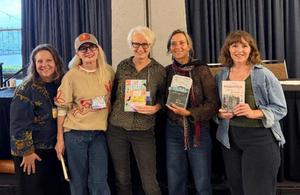
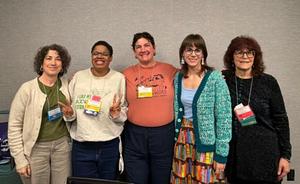
| (l.-r.) Kim Bissell, Betsy Gaines Quamman, Amy Stewart, Helen Whybrow, Elizabeth Grey | |
Bookseller education programming was concentrated on Tuesday, following an education plenary author panel, "Writing on the Wild Edge: Women Writers on Landscape, Language, and the Living World" with Betsy Gaines Quammen (This Haunted Land: Reckoning with Ghosts and Stories That Shape America; Torrey House Press); Amy Stewart (State Bird: A Nation Elects Its Feathered Representatives; W.W. Norton, March 2027); Elizabeth Grey (Migration: A Memoir of Moving On; Milkweed Editions, February 2027); and Helen Whybrow (The Salt Stones: Seasons of a Shepherd's Life; Milkweed Editions), moderated by Kim Bissell, owner of Broadway Books in Portland.
|
|
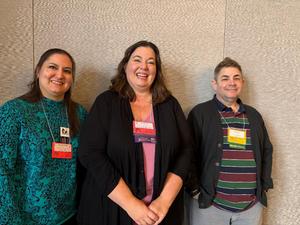
| From left: Ronnie Kutys, Jenn Foley, Rafe Posey | |
Book Mail: How to Get It and Why You Should
"Book mail" is a phrase used by Rafe Posey, manager at Third Place Books, Ravenna, Seattle, Wash., to describe the various types of communications a bookseller can have with other industry professionals beyond the bookstore. Posey, who developed this session, drew on his three decades of experience as bookseller and writer, "slowly" making connections within the broader bookselling and publishing community that, he said, "completely transformed my life as a bookseller, as a writer, as a reader.... I want to make it easier for you [booksellers] to get your hands on more ARCs and especially, I want to you to be more involved in the bookselling community and in things like making publishing more diverse."
He was joined by panelists Ronnie Kutys, associate director, retail marketing, HarperCollins, and Jenn Foley, member relations manager, American Booksellers Association, for a discussion focused on the various means--e-mail, social media, Edelweiss communities, relationships with sales reps and booksellers around the country, and actively engaging in ABA programs like Indies First and Indies Introduce--through which a bookseller can become more involved in what Posey says is "an amazing ecosystem that we get to play in."
Foley outlined several ABA programs available to booksellers that foster bookseller and publisher engagement, with particular attention paid to Indie Next, Indies First, and Indies Introduce, which Posey described as "the best thing ever."
Kutys described the ABA programs as opportunities for indie booksellers to "use your voice" that, along with e-mails to publisher reps and author event requests, are factors that "play into what we are thinking about." Mentioning HarperCollins's Instagram account just for booksellers, harperplusbooksellers, Kutys added, "We want to be sure you all know that you can get in touch with us... we are approachable, we want you to talk to us."
Supporting professional development, Posey encouraged attendees to subscribe to ABA's Bookselling this Week, Shelf Awareness, regional newsletters, and the "unhinged and amazing" newsletter from Riverhead.
Panelists also discussed using Edelweiss communities as an alternative form of social media, allowing for connection and community that, Posey said, "strengthens your whole ecosystem... and creates lifelong friendships with people you otherwise wouldn't get to meet."
|
|
|
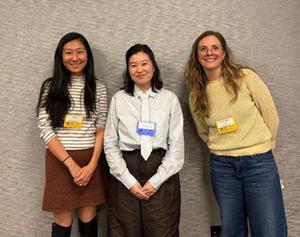
Lucy Tan, Elaine Cho, Becky Merilatt |
|
Scrappy Events for Small Bookstores
Panelist Becky Merillat, co-owner of Ridgecrest Books, Shoreline, Wash., described efforts to move away from the "toxic feeling" some get from social media by building an events program focusing on face-to-face and hyperlocal events. She was joined by Elaine Cho, author of The Final Death of Namjoo Han (Saga Press/S&S, April 2027) and Shelf Awareness editor; and Lucy Tan, author of Tiger's Mouth (Ballantine Books, November 2026) and a bookseller at Secret Garden Books, Seattle, Wash, to share ideas for building community relationships between bookstores and local authors through events that may not have publisher support.
As an example, Merillat wrote to Cho directly, offering to host an event that Cho's publisher had declined to support, saying, "We don't think you'll pull enough people." Cho and Merillat invited another local author to create a "double-header" event.
Tan also experienced the limitations of publisher support. "I was getting the sense," she said, "that I wasn't getting all the invitations that were sent to me... I think that publishers... don't love offering you something to you if they're not willing to fund it. And sometimes they may not have the manpower to help if they don't feel like direct sales are correlated." But, Tan pointed out, "I'm not necessarily looking for that. As a local and debut author... I'm looking to find readers."
The panelists agreed that "scrappy events" are often small events and pointed out that establishing realistic attendance expectations is important. Merillat described herself as "very up front" with local authors that it may be up to them to bring the crowd.
Developing word-of-mouth in advance of an event is another important area for bookstore and author collaboration. Merillat prepares with in-store and window displays and Cho has found that making short videos for social media that talk about books that inspired her writing can draw attention from readers who aren't familiar with her novels.
 |
|
|
From left: Lorie Lieberman, Katherine Morgan, Gene Cook, Alyse Wecker, Cynthia Frank |
|
Strange Bedfellows: Unlikely Partnerships That Strengthen Your Store
Three booksellers, one publisher, and a high school librarian offered experience and advice for an eclectic range of bookstore partnerships with local individuals and organizations. Panelists were Alyse Wecker of Maggie Mae's Bookshop in Gresham, Ore.; Cynthia Frank, Cypress House, Fort Bragg, Calif.; Katherine Morgan, Grand Gesture Books, Portland, Ore.; Lorie Lieberman, teacher/librarian, Portland Public Schools; and Gene Cook, Spoke and Word Books, Milwaukie, Ore.
Frank opened the discussion by noting partnerships with her local bookstore, Gallery Books, Mendocino, Calif., that included an event selling how-to and training manuals in partnership with two local builder supply stores, a program with the rural opportunities and education center, and several California Arts Council grants for readings and "new style performance in some odd venues."
Wecker approaches her collaborative thinking with the question, "I don't know what I don't know, but what would it look like if...?" This question has been answered in ways that included events with a local estate planner, a tattoo artist, a gardener, and a Lego Masters contestant. Maggie Mae's also does a regularly scheduled white elephant gift exchange, book swaps, and paint nights in partnership with a local library.
In Portland, Morgan and Lieberman collaborate on the production and promotion of adult and YA romance book club author events hosted at a local school.
Cook, having served on her local city council and other municipal committees, offered insights about taking advantage of government programs that support business. "For the most part, the people in your government want to help, but need to know what you need." Cook reported that government support can provide development grants, coaching, training, access to licensed software and even, when the store mentioned it, a much-needed bicycle rack. Additionally, Cook noted that identity organizations (e.g., women, Black, LGBTQ+) also offer support and resources. --Neil Strandberg