

 Bookshop.org recently marked a striking milestone: since it launched in early 2020 primarily as an online book-buying alternative to Amazon, it has given more than $50 million to independent bookstores in the U.S. (The money comes from of a pool consisting of 10% of sales that Bookshop makes directly to readers, not through a bookstore, or through non-bookstore affiliates such as newspapers or other organizations, with the money distributed even to indie ABA-member bookstores that don't use Bookshop.)
The pool is just one of the many ways Bookshop supports indies. Beyond offering an easy way for stores to sell printed books online, it's added e-books and audiobooks, expanded abroad, improved its site, and has plans to "make life easier for booksellers," including creating an e-reader and adding more online content to make Bookshop "the best place on the internet to buy books."
One early way Bookshop helped indies was unforeseeable: when the pandemic hit right after Bookshop's launch, Bookshop was a life saver for the many indies that didn't have e-commerce capabilities or even websites, offering an easy way to sell online when most in-store transactions ended.
 |
|
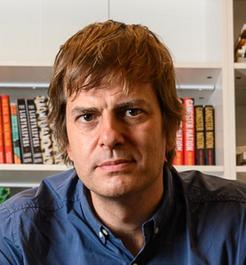
| Andy Hunter | |
In conversation with Shelf Awareness, Bookshop founder and CEO Andy Hunter readily acknowledges that the company's launch was well-timed. But, he emphasizes, the timing had more to do with Bookshop's original goal: to be an alternative to Amazon for online purchases of books. "I felt Amazon was growing too fast," he explains. "Customer habits were getting fixed, and we couldn't let it go on."
Hunter was considering launching later because he hadn't raised the full amount he thought he needed. (Bookshop owners include Hunter, the American Booksellers Association, Morgan Entrekin, Bookshop staff, and others.) Still, Bookshop launched at the 2020 Winter Institute in Baltimore, in what Hunter calls "a kind of a miracle. If I didn't feel the urgency and we waited three months, we wouldn't have been ready."
Some 1,200 indie bookstores signed up in six weeks. Bookshop's growth continued at a pace beyond the company's forecasts, with Bookshop "twice as big as we ever expected." Bookshop now has 3,000 stores, more than 90% of the ABA's membership. Last year Bookshop sales grew 55%, and are up in "double digits" this year so far. For most stores, "We're between must have and nice to have," Hunter says, though for many small, rural stores, "We're essential."
If a bookstore has a link to Bookshop, it gets the full profit of 30% of the cover price, regardless of whether Bookshop discounts the title. (Bookshop's discounts are generally not more than 10%.) The money that goes to the indie bookstore pool represents 10% of the sale of books that Bookshop sells directly to consumers or for non-bookstore affiliates. That money is paid out twice a year and is divided in a way so that stores with multiple locations get a bit more than stores with a single location.
In the beginning, some bookstores were concerned that Bookshop would cannibalize sales, but as Hunter points out, "The vast majority of our customers are coming from having shopped on Amazon." He pointed to "a shift in the cultural conversation" whereby "support for indie stores is a socially conscious decision. People see indie bookstores as central to local communities, as advocates for literacy, raising a new generation of readers, and creating a healthy culture around readers."
In addition, "the more we slip into oligarchy and see [Amazon founder Jeff] Bezos at the inauguration and contributing to the ballroom," Hunter continues, "we see what indies mean for free speech, the open marketplace of ideas" as well as a solution to the problem of "massive consolidation making it hard for new authors to break out."
Booksellers have a highly favorable opinion of Bookshop, with a survey showing 98% with a positive view and 94% ready to recommend Bookshop to a new bookseller.
Since 2020, Bookshop has expanded in various ways. It has launched in the U.K., and offers e-books there and in the U.S. In both countries, e-books represent about 5% of sales. For audiobooks in the U.S., Bookshop has a partnership with Libro.fm.
Among its plans, Bookshop wants to expand the platform so that "any bookstore anywhere in the world will be able to sell e-books on our app," Hunter says. Booksellers associations in Canada, Australia, Brazil, and Greece have expressed interest in working with Bookshop, he says.
Bookshop would like to release a reading device, "a Kindle killer." Because the expansion of AI has boosted the price of memory devices, Bookshop can't build one on its own at the moment but is "looking for other ways to bring an e-reader to market through partnerships." Hunter notes that while some people read e-books on their phones, most read e-books on devices--and those readers read 10 times as much as those who read on phones.
Hunter stresses, too, that a Bookshop e-reader would be sold in a way that offers bookstores "decent profit margins" on the device. Also, unlike previous e-reader partnerships, stores would get the full profit from e-book sales.
Bookshop wants to be "the best place on the internet to buy books," a goal that Hunter says involves "a million small things." This would include, for example, adding reviews and books discussions, author interviews, videos, and more. "In the age of AI we want to do more for human curation, to lean into human recommendations and human booksellers."
Bookshop wants to make bookselling easier for booksellers in a variety of ways. For example, Bookshop would like to give customers the option of picking up an ordered book in-store. The company also wants to do more digital marketing, e-mail marketing, and social media marketing.
Bookshop would also like to improve reporting and help solve book world tech problems so that, Hunter says, "if a person wants to start a bookstore and has an iPad, they should be able to sign up with Bookshop and sell online, and all hardware and software would be streamlined. By removing all the barriers to starting a store, it makes more stores sustainable, and more stores will open. This is our ultimate mission, beyond just taking all Amazon customers and converting them to Bookshop customers." --John Mutter