

"As a publishing community we talk a lot about through lines," said Christie Henry, director of Princeton University Press, at the Frankfurt Book Fair in Frankfurt, Germany, Thursday afternoon. "Climate change is a through line of our contemporary society and any future society that we can create."
 |
|
|
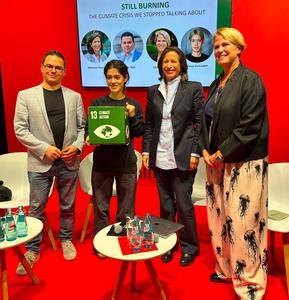
(l.-r.) Özden Terli, Darya Sotoodeh, Melissa Fleming, and Christie Henry. |
|
Henry was part of a panel entitled "Still Burning: The Climate Crisis We Stopped Talking About." Arranged in partnership with the United Nations, the discussion featured UN Under-Secretary General for Communications Melissa Fleming as moderator and speakers Özden Terli, meteorologist for Zweites Deutsches Fernsehen, a German public television broadcaster, and Darya Sotoodeh, spokesperson for the climate activism group Fridays for Future.
The group discussed how climate change has slipped from media coverage and political agendas around the world even as extreme weather events occur with increasing frequency, and what the publishing industry can do to help fight disinformation and create positive change.
Fleming reported that the past 11 years were the warmest 11 years ever recorded, yet since 2021, global media coverage has fallen almost 40%. Newsrooms "all over the world" have cut their climate desks while fossil fuel companies and their allies are "flooding the information space with falsehoods." And those who tell the truth about climate change in the media and elsewhere face online harassment.
Terli recalled that as he made forecasts earlier this summer before and during Europe's record heatwave, there were people claiming that this level of heat was not unusual and that summers used to always get that hot. Climate change disinformation, much of it funded and supported by fossil fuel companies, remains an "ongoing thing" that is "destabilizing society." People are being told "it's not so bad," Terli said, when the situation is "exactly the opposite."
Given the "huge amount of carbon dioxide" already emitted, societies will be dealing with rising temperatures for the next decades; on that timescale, climate change is "not stoppable." The atmosphere that exists today, he continued, is not what it was in pre-industrial times or even 40 years ago. "It's a different atmosphere and it's generating different weather," with "catastrophes," like this summer's European heatwaves, "already locked in."
Henry brought up the "aggressive defunding of climate-based research," which is becoming an alarming trend. In the U.S., the Environmental Protection Agency's Office of Research and Development, which was an independent research organization with projects all over the globe, was shut down and dismantled in 2025. The National Science Foundation is "down $310 million in research from fiscal year '25 to fiscal year '26," and it has terminated grants for more than 100 climate-related projects. The stance of the Trump administration is that any active research must align with the administration's priorities. Henry also pointed out that this is not contained to the U.S.--the Guardian reported this spring that the U.K.'s Biodiverse Landscape Fund is down some £100 million in funding.
Sotoodeh said she and her colleagues have noticed a clear "shift in the discourse," with interview requests and panel invitations becoming less frequent. Attention has shifted to such issues as war, inflation, migration, and the rise of the far right, but all of those crises will worsen as the climate changes. As food scarcity and natural disasters destabilize things and lead to further migration, "people will even more vote for extreme parties," Sotoodeh asserted.
It has become increasingly important to show that climate activism is linked to both the fight for social equality and the "fight against fascism," Sotoodeh said. She remarked that the way the climate crisis is currently framed, most people imagine it as a looming "apocalypse" where once it happens, "everything will be gone," while efforts to mitigate or adapt to the effects of climate change are seen as restrictive and punishing. She identified both of these as harmful misconceptions, emphasizing that the crisis is not looming, it's "happening right now," and adapting to climate change affords people a "huge chance" to "change the way we live" and "become better."
Henry said the publishing industry has "great opportunities here and significant responsibilities." Publishers have to use their platforms to tell these stories "in fiction and nonfiction form," while making them interesting and important. The industry also has to make sure the "balance of evidence-based publishing" matches or even outstrips "the pace of disinformation being put into the world."
"A lot of solutions" are already available, Terli said, pointing to renewable energy sources such as wind and solar, advances in batteries, and electric vehicles. The technology is getting cheaper, and there will be a point when it is "too expensive" to buy things like fuel-burning cars or generators. He acknowledged that humanity has reaped huge benefits from burning fossil fuels, but "we have no time anymore" to wait.
He stressed that people shouldn't sit at home thinking they're the only ones who care; when he gives talks about climate change, plenty of people attend, and the most commonly asked question is why more action is not being taken.
"It cannot be our future that when we are old, we die because it is too hot," Terli said. "So we have to change something. We have to work together, and we have to show the people the chances we have for a better future." --Alex Mutter