

"Trust in the news has fallen to the lowest level they have ever recorded," reported Melissa Fleming, UN Under-Secretary-General for Communications, at the Frankfurt Book Fair in Frankfurt, Germany, last week.
 |
|
|
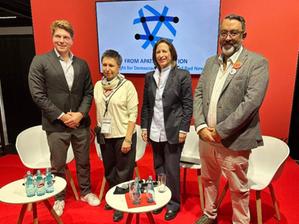
Left to right: Marten Risius, Yuliia Kozlovets, Melissa Fleming, Sherif Bakr |
|
Fleming was the moderator of a panel discussion entitled "From Apathy to Action: The Fight for Democracy in an Age of Bad News," that included speakers Marten Risius, a professor at Neu Ulm University studying online trust and safety; Yuliia Kozlovets, director of the International Book Arsenal Festival in Kyiv, Ukraine; and Sherif Bakr, general manager of Al Arabi Publishing and Distributing in Cairo, Egypt. They discussed online misinformation and disinformation, news fatigue, and the role books can play in combating them.
The newest digital news report from the Reuters Institute, Fleming continued, has found that more than four in 10 people around the world "avoid news altogether," and more than six in 10 people "say they worry about telling what is real from what is fake online." Disinformation and clickbait increasingly "shape what we see" online, Fleming said, and it is "no wonder that many of us go on a so-called news diet." But switching off comes at a cost, as "we risk becoming disengaged at the very moment our democracies need informed and active citizens."
On the subject of today's information environment, Risius noted that people often say that there are "no gatekeepers anymore," but that is not exactly accurate. Traditional gatekeepers like news agencies are now in the position of trying to reach audiences through online platforms, which are the new gatekeepers. And while the traditional gatekeepers used to have standards of things like source credibility and verification, there are "other mechanisms at play" with social media, mainly attention and engagement.
Risius said a blog post written by Mark Zuckerberg in 2021 does a good job of illustrating how social media has altered editorial practices and content policies, and the harm it can lead to. The post described a "spectrum of content" where on one end there is "very unproblematic content" like cat videos or photos of someone's lunch, and on the opposite end, there is content like child sexual abuse material or terrorist videos. At some point between those ends of the spectrum, Risius explained, social media platforms have to decide where to "draw the line" on what they do and do not allow.
While platforms are "fairly good" at keeping out the truly extreme content, he continued, the closer content comes to that line, "the more engagement you see." When users encounter "borderline content" or "gray area content" they clash with users holding opposing views, and in response to that, "the algorithm picks it up" and shows that toxic content to more users.
Kozlovets described the exhaustion and fatigue felt by Ukrainians in the "fifth year of the full-scale invasion." Those on the frontline are of course exhausted, but even those living far from it have been worn out by the continual danger and unpredictability. Though people try to get used to it, "you cannot feel it like a normal situation." That exhaustion, as well as a feeling of helpless, can lead to apathy.
At the same time, "information fatigue" can also lead to disengagement. It is impossible to remain alert all the time, Kozlovets said. One cannot monitor Facebook, Instagram, and Telegram channels for 18 hours a day. "You need to go to the grocery store, you need to go to the doctor. You need to switch off this fucking phone." Doing so can take you "back to your agency."
Kozlovets called books "crucial in this moment," saying she looks to them "as a method and instrument" of keeping going, even in this "awful situation." Reading is a mechanism through which people can survive and cope, because "when you are diving inside, you are safe." Book events like IBAF make people feel a return to agency and feel like they're not alone. It works as an "antidote," with people feeling that "we are here, we are alive, and we are not, you know, giving up."
Bakr recalled feeling overwhelmed and made helpless by images and videos coming out of Gaza. It "really breaks your heart," he said, and for many people, "you start not opening these videos" and disengaging. But as a publisher, he has recognized that when "some kind of a crisis" happens, people "run to the book," as they still see books as sources of trustworthy, credible information.
When people rely on social media platforms for news, he said, "there are gaps in the market," and publishers should look to "fill in the gaps" with the books they publish. As examples he pointed to books his company has published about Gaza, an Italian book about drone warfare and "how terrible that can be," and a Canadian title about how "people are numb towards news now." Literature helps people make sense of what's happening, "whether it's wars" or "the phenomenon of misinformation," Bakr said.
He pointed out that it's not only about providing information but also about providing comfort. It is important to translate books from Ukraine, he said, in order to "hear them, feel them, humanize them." For Gaza, he has published books about geopolitics and history, but he has also made sure to publish books not just about war, but about daily life and going to the doctor, about people's dreams. That way, "you feel it's not just a building that fell or books that were burned," Bakr remarked. --Alex Mutter