

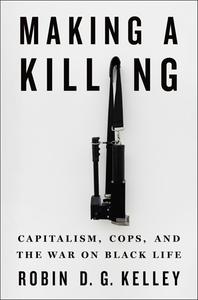
 Names like Breonna Taylor, Michael Brown, and George Floyd made headline news in the United States, and further afield they're often represented as singular cases of extreme brutality by the police. But as Robin D.G. Kelley, the Gary B. Nash Endowed Chair in U.S. History at UCLA, deftly shows in Making a Killing, these losses are not isolated incidents or the fault of a few overzealous officers. These deaths are drops in an ocean of state-sanctioned violence against Black people in the U.S. that dates back to slave patrols and continues through the expansion of ICE and the rise of Cop City developments. He writes, "What we're witnessing and naming as 'fascism' is an escalation and expansion of a much longer war, one that has for centuries targeted Black and other colonized people." The described fascism is "a coercive, authoritarian system that turned Indigenous people into slaves, workers, peasants, peons, police, soldiers, concubines, and corpses through violent dispossession, enclosure, taxation, forced labor, imprisonment, and law."
Kelley does not present a single timeline; instead, he disentangles the intergenerational legacies of systemic abuse, poverty, and racist destruction that tell a recursive story of Black life in the U.S., one where the process of economic extraction that was cemented during the nation's period of chattel slavery becomes inexorably tied to the country's so-called economic and social progress. In fact, Kelley demonstrates how various "wars" on issues such as crime, drugs, and militancy have simply been mechanisms that have facilitated the extension of the U.S. prison system and the further militarization of police forces especially in predominantly Black neighborhoods. The assault is not only physical but also financial: as funding is diverted to shoring up these institutions, it is at the expense of housing, education, and other community resources.
Kelley rightly frames the history of inhumanity against Black communities by the state as a war and the victims as casualties of war. He points out the consistent volume of aggression that never even made national headlines. But he also makes sure to weave the long history of resistance to these unjust systems into the narrative, to make clear that as long as the arc of the violence has been, so too has been the arc of movements, thinkers, and coordinated efforts to draw attention to this violence. Kelley emphasizes that there are still collective efforts that work to imagine that one day the killing might stop and that better futures are possible. Making a Killing is a brutal, necessary history of Black life in the U.S. that has the power to reframe how readers perceive the history and narrative of the nation. --Michelle Anya Anjirbag, freelance reviewer
Shelf Talker: Renowned historian Robin D.G. Kelley presents a horrifying but long overdue comprehensive history of the violent, state-sanctioned oppression of Black people in the United States.