

Show his eyes and grieve his heart. Come like shadows; so depart.
--The Witches, in William Shakespeare's Macbeth (Act 4, Scene 1)
In the spirit, literal and figurative, of the season, I sensed that a bookselling ghost story was in the air. So I embarked on an exploration into the spectral depths of the New York Public Library's digital archives. There, I communed with an 1873 obituary in the Times for Charles Knight, a notable English bookseller, publisher, editor, and author--a bookish wraith.
|
|
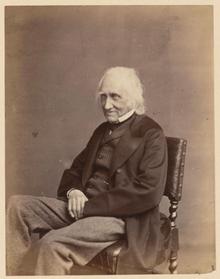
| Charles Knight c. 1865 (courtesy Rijksmuseum) |
|
His father was a respectable Windsor printer and bookseller who rose to become an alderman, and eventually mayor. The obit describes Charles as having been "a studious and observant boy... who became the companion of his father's leisure hours and from him he picked up the first scraps of that 'store of information' which he subsequently garnered and used so well."
Later, at Ealing, Charles "seems to have been but a desultory student, and one who, in spite of the gifts of a very quick and retentive memory, likes English lore far better than his Latin Syntax and Prosody," the Times noted. In his autobiography, Passages of a Working Life, he recalls that after two years at Ealing he was "uprooted from the congenial soils of school to be planted once more on the arid sands of Windsor, as his father's apprentice and to become his own instructor."
All was not drudgery. The obituary recounts his at once imaginative and skilled restoration of a first folio of Shakespeare's plays that had been "sadly defective in many places." Although he eventually sold the copy, "many years afterwards this 'imperfect copy' of our great poet's works blossomed into the Illustrated Shakespeare with which Charles Knight's name will for ever be associated," the Times noted.
Taking advantage of his father's printing facilities, Charles began, at the age of 21, a career turn: "It now became clear to me that my only way of escape from the petty cares of the trade of a country bookseller and small printer was to make literature, in some way or other, my vocation. It was not by writing commonplace essays and occasional odes and sonnets that I was to carry out this purpose. If I was to accomplish anything, I must have a Locus Standi. There was my father's printing-office; he was not without capital. Windsor was without a newspaper. Some day, not very far off, perhaps, should my ambition gain me the conduct of a journal."
And so it did. His ghost story continues on in the obit as a chronicle of significant accomplishments in literary and publishing realms. It's a tale of seduction not unfamiliar to those of us who toil in the book trade: the irresistible lure of a life devoted to words; the challenge of finding one's way along the bedeviling twists and turns of forking pathways; the maddeningly unfinished drafts of our personal bookish ghost stories.
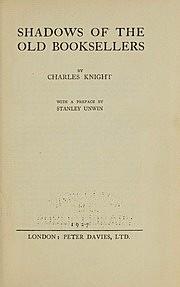 While exploring Charles's tale, I found myself drawn to Shadows of the Old Booksellers, an intriguing book he wrote during his "declining years" in Hempstead, where his "venerable, but genial and pleasant face and snow-white locks were familiar to rich and poor, old and young."
In the book's introduction, Charles proposes that he will attempt "some delineations of a series of personages whose doings may, upon a hasty view, appear to have too much of a commercial character to be generally interesting.... The subjects of the present outlines, with a few exceptions, are little fitted for imaginative pictures of startling adventures, or of curious details of domestic life. But they have another sort of interest. They flit before me, ever accompanied with shadows of many of the immortals of literature. They are obscure and ill-defined until the period of the Restoration; but when a reading public is beginning to be formed, they become something more than names upon titlepages.
"As they walk the earth, from the middle of the seventeenth century to the end of the eighteenth, I see a band who, during five generations, have been carrying forward the great work of national enlightenment, sometimes, indeed, in a narrow and mercenary spirit, but not unfrequently in a spirit far above that of mere money-getting. I am not about to write their biographies. They will 'come like shadows, so depart'; but as they pass over the stage, they will tell something like a connected story of literary progress, in its commercial relations, up to a time when my own experience, imperfect as it was, enabled me to catch some glimpses of its modern aspects."
In his search for spirits of bookselling's past, Charles takes on the role of medium with invocations like:
- I can see the shadow of the young bookseller as he sits in his shop amidst his small stock...
- I would call up his Shadow, as it appears to me under the one gleam of romance which lighted for a moment his solitary pursuit of the great purpose of his life...
- I can scarcely resist the desire to call up the Shadow of this old man, to relate the changes which he had witnessed in his professional experience...
- Let me endeavour to realize the shadow of the figure and deportment of the young bookseller...
This, indeed, is a proper week to call upon eternal shadows of the old booksellers. Happy Bookish Halloween.