Wednesday July 22, 2026: Maximum Shelf: Life Out of Order
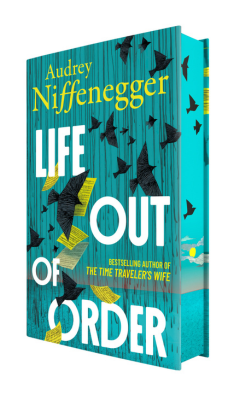
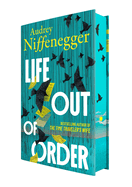
Life Out of Order
by Audrey Niffenegger
More than 20 years after her runaway success with The Time Traveler's Wife, Audrey Niffenegger returns to the DeTamble family, chronicling the story of Alba, daughter of Henry and Clare, in her fourth novel, Life Out of Order. A composer, a musician, and a time traveler like her father, Alba must navigate the complications of life, career, and love in a world being constantly reshaped by powerful forces: political events, artificial intelligence, and the effects of rampant climate change.
Niffenegger begins her narrative in 2022, when Alba is in her 20s and already dealing with myriad decisions forced by her time-traveling ability. She travels by either years or decades; her slips in time, whether minor or major, force her to pause and consider where (and when) she is, and with whom. After studying music at Northwestern University, she is ambivalent about a public music career; her time-traveling condition makes her unsure about performing, or her ability to sustain a teaching job. She and her widowed mother, Clare, have gradually drawn around them a ragtag band of friends, a found family: artists, activists, and political organizers, some of whom are related by blood, and all of whom care deeply about beauty and community. As she travels back and forth in time, she returns to these people in her home city of Chicago and their quietly fierce, grassroots fight to hold onto what is important as the world is falling apart.
Although Alba can't always choose where or when she goes during time travel, she often ends up in familiar places, most notably a rambling yellow house that becomes an anchor point for both her and the narrative. The house also functions as a way station (and home) for Oliver, a fellow time traveler and classical pianist who made his way, alone, from Shanghai to London as a teenager to study music: "To the Chinese government I'm a dissident. To my parents I was a treasure to be hidden away. To people in my own time, I'm a pianist." His life and Alba's remain intertwined over many years; their bond is further complicated by Alba's connection to Zach, a quiet, steady non-time-traveler who becomes her husband and is also, later, connected to Oliver. As one might expect, falling--or staying--in love as a time traveler is complicated, and Alba does her best to treat both men with kindness, while never quite knowing how long she'll remain in one place, with either or both of them.
Some of the narrative's flashbacks are expected, such as Alba's memories of learning to play the violin with her grandfather, Richard, or spending time with her father as a child. But, of course, most of her memories and much of her present are complicated by time travel: hers, her father's, and occasionally other people's. Alba often knows, at least in broad terms, something about events in the future, relative to whatever time she happens to be currently standing in. She also knows that revealing these futures--especially the stressful ones, like pandemics and climate disasters--will mostly cause confusion and upset. "My dad always said no, you can't change anything. It will all fall into place, the same again and again, or, rather, it happens once and we can't change it. And I have never been able to disprove that. Even those of us who are let loose in time must abide by the rule: everything has already happened, and we cannot ever change it." Gradually, she comes to believe that revealing the future to her loved ones means robbing them of their ability to choose how to navigate their own present. The weight of these secrets proves heavy, but Alba is determined to walk through time with care--even as she is forced to do it non-linearly.
Though Alba is the main focus of the narrative, Niffenegger also devotes considerable space to her artist mother, who has found new love in a surprising place: with Beck, a Black, Detroit-born digital artist and creator whose Museum of Lost Souls becomes increasingly important to both Alba and her family. Overseeing the museum is Isadora, an artificial intelligence created by Beck. Originally conceived as a curatorial presence, Isadora evolves beyond her initial purpose, becoming a kind of daughter to Beck and stepsister to Alba. Isadora's presence provides a way for Niffenegger to interrogate the use of AI as it connects to art, relationships, and human innovation.
As the narrative continues, Alba and her friends and family, especially Oliver, must contend with the ramifications of significant climate change. Many elements of the novel feel eerily similar to the 21st-century world and dissimilarly dystopian, and the characters each deal with fear, scarcity, and danger in their own ways. As the waters begin to (literally) rise, Alba and a few others are left to preserve and protect what they can, even while they know they cannot stem the tide of time.
Powerful, wryly humorous, and tender, Niffenegger's narrative asks big questions about community, making art, fighting against the darkness and doing one's best to create, preserve, and care for the good amid times of intense turmoil. --Katie Noah Gibson
Hanover Square Press,
$33,
hardcover, 560p., 9781335003232,
October 6, 2026
Audrey Niffenegger: Creativity and Community Across Time
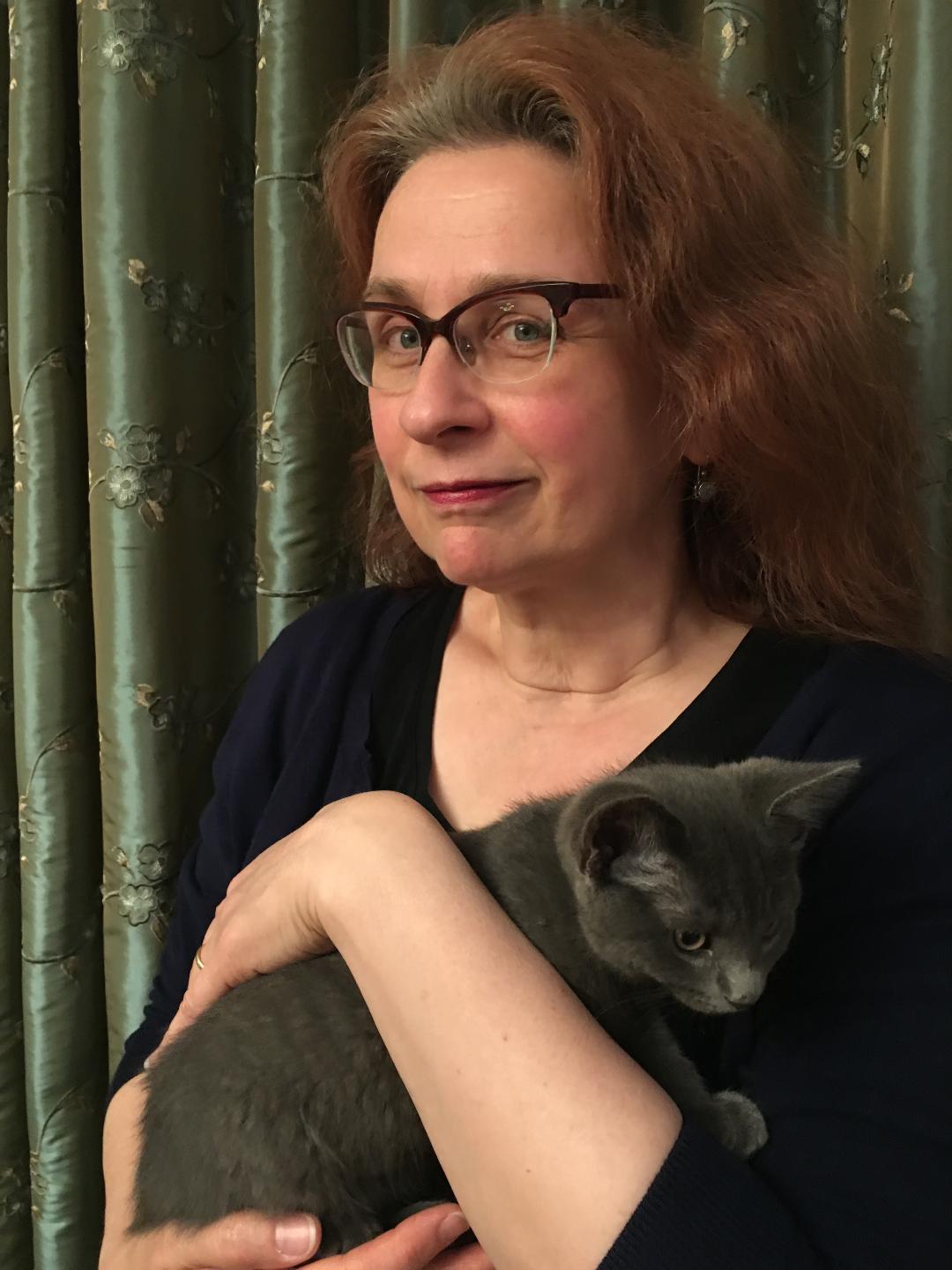
Audrey Niffenegger with Sylvie (photo: Eddie Campbell)
Audrey Niffenegger is the author of the novels The Time Traveler's Wife, Her Fearful Symmetry, Raven Girl, and several comics and visual novels. She divides her time between London and Chicago. Life Out of Order (Hanover Square Press, October 6, 2026) is the follow-up to the immensely popular The Time Traveler's Wife.
What made you decide to revisit the world of The Time Traveler's Wife more than 20 years later?
I started writing this book in November 2012, when the national mood was very different than it is now. I was interested in writing about climate change. I also had this idea about Alba [the protagonist] having a house, a place she has a strong tendency to return to. It was very different from Henry [Alba's father, the protagonist of The Time Traveler's Wife]--I couldn't just dump Alba in a meadow somewhere; as a female time traveler, the danger for her of that would be tremendous.
I was also interested in writing about art and community. Alba has a strong family, made up of both people she's related to and friends, who are all artists in some way, and also politically involved. I thought it would be interesting to tackle the ways that one's artistic life and the life of the community intersect and overlap. Every work of art has a constellation of questions that come with it, and I've enjoyed this new work with its attendant questions.
The book deals deeply with the role of art and artists in society, especially in times of rapid change.
Alba and Oliver, as well as others in the book, are artists: musicians, sculptors, creators of some kind. A lot of the book is concerned with their attempts to preserve, share, and pass along anything of value. I was also thinking about the way we teach art to children, and how it has such a huge impact. It can make such a difference if you're teaching art to someone in a way that makes them love it, rather than hate it.
There are so many different ways of being human. I like it when people really take it out there and are kind of being their maximum selves--quirky, eccentric, just plain weird. I like variety. I want people to be inventive and crazy, and amuse me with their marvelous new things that I've never seen before. Alba, with her millions of secrets, is also just trying to get along and protect people, and make her art, and love who she loves. All the characters have a kind of desperation to nurture each other, whether it's with art or food or political organizing--any resource that's available. All of them get by by giving.
Because of her time-traveling ability, Alba often knows what will happen in the future, but she can't change these events. She often has to consider whether and how to reveal what she knows. This impacts her relationships with other people.
It's always interesting with a time-travel novel, because I could reveal basically anything to the reader at any point. Trying to figure out how to dole out information, and let the reader experience the building of relationships and plot, is always a delicate balance.
Alba thinks of herself as a chaotic person, but especially as she gets older, she repeatedly realizes she has said something she shouldn't have, or let some piece of information get loose. Because of her time-traveling ability, she finds it oppressive to keep all these secrets, and also to say what needs to be said. It has weighed on her, because she knows well in advance how people's lives are going to go.
The bedrock of both of these books is free will vs. determinism. For most of the characters, as long as they don't know the outcome of a certain event, they are free to make decisions. For Alba, who has already lived through certain events in the future, she knows what's going to happen. Alba is always doing her best not to tell anybody the future, because she knows she's taking away their ability to decide. When she talks about an event, she often ends up saying, "That's just what is." There's no point in telling anyone about events like pandemics or elections beforehand; everyone would be so dispirited, or elated, that they would not be inclined to make an effort, so you're removing their free will. They just become cogs in this deterministic machine.
Artificial intelligence plays an important role in the novel, especially in the form of Isadora.
Isadora kind of got in there by accident. When I had the idea for the Museum of Lost Souls, I thought: it's a museum, so it needs a curator. I'll make a digital robot character to be the curator. Alan Turing wrote an essay about a process for developing a realistic AI: essentially raising them as a child, bringing them through the stages of development. That seemed like an interesting, provocative idea: to have Beck [the museum creator] actually do this experiment, beginning with Isadora as a child, and gradually bringing her along until she's an adult consciousness. She's a benign AI whose purpose is to preserve and curate and keep all this stuff, so at least it's there in some digital form, though I would never argue that the digital and the physical are equivalent. The Museum of Lost Souls is meant to record all these things that have either been lost or might be lost. I wondered: If we're not going to take care of the planet, and we allow things to be lost, how do we carry on? What comes next?
As the novel progresses, the characters, especially Alba and Oliver, must deal with the effects of rampant climate change.
With time travelers, you can go wherever: nobody can enforce a border on you. I wanted to show, over and over again, how things happening at a large level--climate change, decisions that governments make--are affecting people at a very nitty-gritty, day-to-day level. Immigration is a big topic, too, which I've dealt with in my life. I think most readers will be touched by at least a couple of these issues.
The novel's approach to climate change (and other issues) is all about managing decline at some point, and this is true of real life, too. I volunteered at Highgate Cemetery in London for a long time, and they have a policy they call "managing neglect." Societies and civilizations rise and fall, and there's a limit to how long you can keep something going once it has gone past a certain point of excess. Capitalism and consumerism have gotten us into this situation where there's just an untenable amount of stuff. Can we get ourselves into the right frame of mind to do what needs to be done to prevent a series of truly dire outcomes for our planet?
Everywhere in the novel, I have embedded the idea of the characters trying their best: to make things, to help each other, to preserve stuff, even if there might be no one to preserve it for. They are doing these things without any sure knowledge that it's going to pay off. I also wanted to show the appeal of grassroots organizing and all the relationships that go with it: the stubborn hope of doing the best you can, even while the world comes undone. --Katie Noah Gibson
Audrey Niffenegger: Creativity and Community Across Time