Tuesday July 28, 2026: Kids' Maximum Shelf: This Is a Door
This Is a Door
by Daniel Nayeri
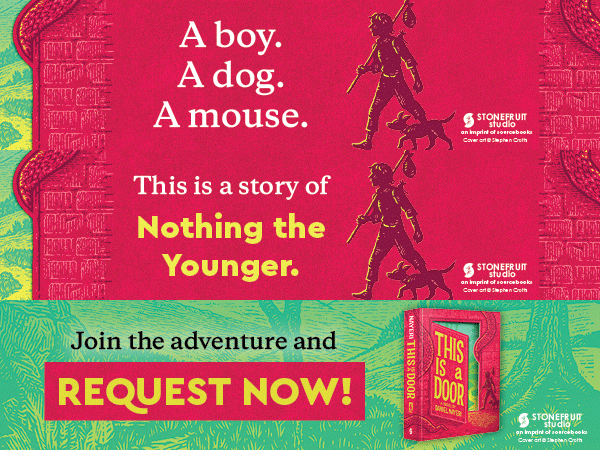
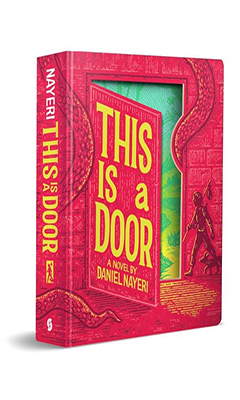
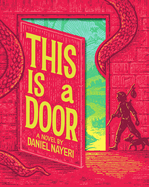
This Is a Door by National Book Award and Newbery Honor winner Daniel Nayeri (The Teacher of Nomad Land; The Many Assassinations of Samir, the Seller of Dreams) is a clever reimagining of the monomyth, or, as described in Nayeri's author's note, "the story of a hero who goes out on a perilous journey, experiences trials, and returns home changed." Here, the hero is a boy who quests with his two friends, a mouse and a dog, each hoping to find their purpose. Nayeri uses an ingenious visual format that offers a reading experience unlike any other, in which text climbs the page, spirals, forms shapes, and expands and contracts.
In the "city on the mountaintop of a far-off and long-lost country" lives 12-year-old Nothing the Younger, or Ing for short. Ing is "nothing much," just a "dull... wiggly creature" with no mother (she died in childbirth) or father (he left after Ing was born). Ing has no job beyond fetching things for people whose names are their "calling," such as Tinker, who tinkered, or the "Wander Prince," who "wandered around adventuring." But Ing does have three loyal friends: Nana, a "beggared widow with a lame foot" who is the closest thing Ing has to a mother; Pöppy, a silly dog who just wants happiness for everyone; and his newest friend, mOmO, a wise, cunning mouse.
Ing believes everyone has a purpose, and he wants nothing more than to discover his. But Nana tells him that to learn his individual purpose, Ing must first find his father so he can ask what his real name was supposed to have been. She encourages Ing to "go out in the world and find your own way," then gives each of the friends an object to help them on their journey: a walking stick for Ing, a scarf for mOmO, and a copper bell for Pöppy. In exchange, they promise that when all three discover their best purpose they'll return and tell Nana all about it.
On their long and adventurous trek, the trio navigate the Land of the Dead, where they help a ghost cross over; assist the Wander Prince in his fight against the terrifying wimmelworm, a crawling dragon who spits fireballs and collects "souls and heartmeats"; and discover the fates of Ing's mother and father. Along the way, Ing almost becomes an apprentice to the lamplighter, who "lights the lamps... that shine the moon into the sky," and a squire to the prince. It is only upon his return home, however, that Ing realizes that his true purpose has been inside him the whole time. With the help of his friends and some life experience, he is finally able to manifest it.
Nayeri follows the story template of the hero's journey and applies the structure to the physical layout of the book by taking 12 elements from the hero's quest and making them the chapter titles. Nayeri expertly combines this metafictional device with playful typography in this illustrated story without illustrations, in which his words do double duty as text and image. In the opening spread, he places the text "A boy named Nothing woke up on the floor" at the bottom of the page. On the next page, "He sat up" is stacked one word on top of another and, on the following page, "high up in the rafters of the stables was a little mouse who had whimpered all night," is placed at the top. This is only one of the myriad ways Nayeri plays with words. Sometimes he experiments within a sentence or expresses the meaning of a word with its letters. To show falling, for example, he lets the letters tumble down the page, and to depict shrubs he staggers the letters. Other times, he uses concrete poetry to create pictures with the text--for example, a lighthouse, a dog, and a broken heart. Nayeri also uses font size and weight to express volume, making the words look the way they should sound: "Boom! Boom! Boom!" fills the majority of the page in bolded capital letters as each word gets bigger and bigger, while whispered sentences appear smaller.
Nayeri's prose can be delightfully musical, packed with internal rhymes and alliteration reminiscent of Lin-Manuel Miranda's rapping style: "Here is a quest to address the distress of a queen whose chests of dresses need refilling," or King Cyrus's request that "every hero here who can hear this, the fearless and peerless best of us (and the careless among the rest of us)" answer his call to adventure. But it can also be simple and straightforward: "The silence grew louder." Both techniques are affective, engaging, and perfect for silent reading as well as read-alouds that will turn the tale into a performance.
This Is a Door is much more than a fantastic study in typography; it explores grief with unexpected depth. Nayeri acknowledges the feelings of overwhelm and numbness that come with loss while leaving space for the hope that follows. The author handles these emotional beats with remarkable nuance. After a tragic event, a blank spread follows, then the words "This is the sound of silence," and then... nothing. It's a simple method but an incredibly powerful one, allowing the absence of words to carry the story's significant weight. This wondrous, inventive, and absorbing novel is likely to have broad appeal with young readers. Lovers of Shel Silverstein's Where the Sidewalk Ends and David Bowles's They Call Me Güero will surely enjoy the concrete poetry and exciting design elements, while fans of Katherine Rundell's Impossible Creatures series or Erin Entrada Kelly's adventurous bildungsroman novels may love the thrill and inspiration of Nothing's hero's journey. --Lana Barnes
Stonefruit Studio,
$19.99,
hardcover, 400p., 9781464246029,
October 27, 2026
Daniel Nayeri, born in Iran, was a refugee for many years before immigrating to the U.S. with his family at age seven. His books have won the National Book Award, the Michael L. Printz Award, the Newbery Honor, the Christopher Medal, and the Middle Eastern Book Award. Here, Nayeri, author of This Is a Door (Stonefruit Studio, October 27, 2026), talks about careening away from traditional formats, developing exuberant text, and believing that a person's ultimate purpose is to be useful for "the Good."
What was the inspiration for this project? Which came first, the story or the concept?
I was sitting around, as we all were, in March of 2020, doodling in my notebook and wondering where I might go in my imagination if I couldn't go anywhere in person. I found myself drawing a book jacket with the text "This Is a Door" over and over again. Eventually, I moved the "a" over a little to the right to look like a doorknob. And from there, I suppose I opened the door and stepped in. I knew I wanted to do something where the text was acting out the story, and for that reason I landed on a hero's journey. Something that hews as closely as possible to a basic plot (in terms of story structure) to careen as far as possible from the traditional format (in terms of type on the page).
When working with the interior designer, what was the process like? Did you work with physical or digital media? How did you convey your ideas?
First, I designed everything by hand in my notebook, and wrote all the text based on those designs. Then I arranged each spread in PowerPoint so that I could present the text in the form I intended it. After that, I worked with a freelance design firm. Lauren Vajda and I met decades ago as entry-level employees at a publishing company (I was in editorial; she was in design), and I have admired her work ever since. When I approached her about it, she immediately understood, and along with her team, took the designs into InDesign--along with many improvements!
The use of ellipsis as berries is so clever! What was your favorite visual to conceptualize, and what was your least favorite or most challenging?
There are so many little Easter eggs I love in this story. For instance, there is another moment when ellipses are used for an extended period of time, and the number of them is measured quite precisely. Without spoiling anything, my favorite parts are when the characters physically move around the page, whether by falling or by searching, or even by crossing over the "great divide" of the gutter in the middle.
The most challenging element is to present dialogue, along with the necessary dialogue tags, in such a way that feels elegant and flows naturally. After all, the traditional format of a novel is already a feat of design.
In some parts of the book, you use the double-page spread as if it were a single page, with some of the text starting on the right side of the page. Can you talk a little about how you made the design work without affecting comprehension?
Readability was a paramount concern for several reasons: first, I wanted the book to still work as a read-aloud or an audiobook because I love both of those experiences. I wanted to avoid puns or sight gags that needed puzzling out and would distract from the story. And I wanted the typographic aspect to feel playful, not esoteric, so that the most reluctant of readers would think of it as an attractive quality, as if the text was so exuberant in expressing itself that it was acting out the message.
As such, I avoided lots of designs that created what I called "multipath reading," which might arise in a crowd scene, for example, if I wanted to show everyone talking at once. We tried to observe the legibility rule of moving the eye from top left to bottom right, giving primacy to one, if not both, at all times. But, of course, these weren't hard and fast rules. The general idea was to prioritize design affordances that grab the reader's eye as quickly as possible after a page turn and take them on a journey across the pages.
There are a lot of emotional beats in the story. How did portray this with text?
In the most emotionally charged moments, I wanted the type to avoid distracting the reader. So, I often pulled back my initial designs in those sequences. There are times the design reinforces the idea that it portrays to amplify, and times when it subverts or counterpositions itself to create contrast (and one would hope, depth of meaning).
What are your favorite hero's journey stories? Which ones most inspired you when thinking about this story and why?
I suppose an adherent to the notion of a monomyth would say "they're all hero's journeys." And that was one of the intriguing aspects to me. I was effectively taking these elements that narratologists present archetypically to stand in for all manner of metaphors--the underworld can be the afterlife but also a desk job, a breakup, or a seedy saloon--and in a somewhat simple-minded approach, I was taking them literally and seeing if I could cobble a story out of them. Of the stories that look the most like a journey, J.R.R. Tolkien's The Hobbit will forever have my heart. Smith of Wootton Major (also by Tolkien) is another, along with King of the Wind by Marguerite Henry and Avi's The True Confessions of Charlotte Doyle.
Finding one's purpose is the main theme in this book. What is your advice for readers struggling to find their purpose?
The line that the main character holds on to is that his purpose is to be "the most useful to the Good God, and least useful to the bad ones." I like this construction because it implies that a purpose is an active calling, "to be useful," and from there guides the individual to ask themselves what their relationship might be with the Good, how can they serve its goals rather than their own. And in doing so, how can they make themselves useless to evil.
What do you most want readers to take away from this story and experience?
I think the best art begets more art. My hope would be that this story enchants and moves readers enough to inspire their own.
And lastly, what's next for you in terms of writing (or design!) projects?
I am still goofing around with hybrid formats. I would love to make a few more graphic novels. I am delighted by the idea of collaborating with designers and illustrators whose work I admire. Here's hoping. --Lana Barnes