Monday August 10, 2026: Maximum Shelf: Ten Perfect Guests
Ten Perfect Guests
by Jonathan Santlofer
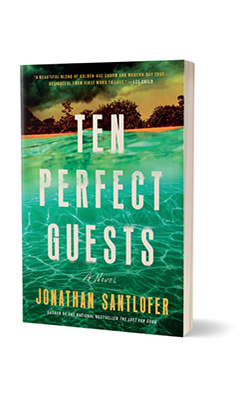
Jonathan Santlofer brilliantly reinvents the closed-circle mystery in Ten Perfect Guests, as 10 flawed, unlikable characters travel to a remote tropical island to learn what (and in some cases, if) they've inherited from a recently deceased, very wealthy artist.
Two rival art dealers, an ex-wife, a lackadaisical son, the current wife, the brother, a failed art critic, a pharmaceutical heiress, a girl no one knows, and a washed-up rock star walk onto an island... except the punchline isn't a joke at all, but the far more sinister threat of death--or perhaps worse, disinheritance. Each has received a custom invitation to the memorial service for the late Victor D'Arcangelo, whose sudden passing has left his immense fortune in question.
For a variety of reasons--debt, pride, desperation, love, resentment, despair, greed, closure--all 10 agree to attend the memorial weekend, held at a remote hotel on a small Caribbean island. Accessible only by boat, and without cell signal, the island that welcomes the group is "part of an atoll... totally self-contained and totally isolated." The hotel is less upscale than the guests expect, and more past its prime, the pediment worryingly inscribed with the Latin Cursum Perficio: "My journey ends here." While the hotel lacks luxury amenities and any staff to speak of, there are comfortable rooms for each guest, a generously stocked pantry, and plenty of flashlights. The well-to-do, spoiled guests are horrified to learn that they're expected to fend for themselves for three whole days before a boat will arrive to fetch them back to the airport.
Santlofer doesn't leave readers questioning what's about to happen to these doomed memorial attendees, although it takes the guests a few beats to come to terms with that destiny themselves. From the one-sentence prologue, it's clear that nothing good is coming their way: "You have to understand. I was going to get caught unless I killed them. I had no choice." From there, Santlofer builds an expertly paced puzzle. As guests start to die one by one, the question becomes not only who the killer is, but who the next victim will be.
Ten Perfect Guests is a thriller in every sense of the word, with a set-up and cast of characters reminiscent of Agatha Christie at her finest. Santlofer pushes the shape of this whodunit well beyond the scope of its locked-island plot, deftly teasing out the backstories of each of the 10 guests on the island in ways that might not evoke sympathy, given the nature of their deceits, but giving nuance and depth to what could easily have felt like flat, one-dimensional villains. They absolutely meet the definition of unlikable in every way: they are selfish, conniving, scheming, presumptuous--and downright mean to one another. Of the Chelsea art dealer, Santlofer writes, "The part of him that had fallen in love with money had murdered the part of him that had fallen in love with art." The European gallerist bullies his way through the world, the abusive voice of his father always in his mind. The widow--who'd been trying to divorce Victor without breaking the terms of their pre-nup--reckons his money will be easier to access now that he's dead. The once-celebrated art critic turned freelance writer seethes over her unjust "retirement" years ago, "her job gone along with her influence and power." The son recalls his artist father demeaning his attempts at visual art; his mother wonders if Victor has left funds for another stint in rehab. The brother longs to return to the past success of his movie career, always overshadowed by Victor's global fame as an artist. The bitter ex-wife, who gave up her own artistic dreams when she married the egotistical Victor, rekindles her affair with the brother. The pharma heiress and her has-been rocker husband loathe each other. And there's also the heretofore-unknown daughter of the late artist. The morally questionable actions of each become even more apparent as guests start to turn up dead. How far will each go to protect their inheritance? And how much farther would they go to protect their own lives?
Ten Perfect Guests is perfectly twisty, with smart reflections on what motivates each of these unlucky guests--both on the island and in the actions that led them there in the first place. An island setting, a series of clues to untangle, and a well-developed and multi-dimensional cast of problematic characters make this a perfect escape, bound to pull readers in, from the ominous opening right up to the final death. --Kerry McHugh
Sourcebooks Landmark,
$18.99,
paperback, 416p., 9781464234811,
September 8, 2026
Jonathan Santlofer: The Art of Unlikable Characters
Jonathan Santlofer (photo: Douglas Lyle Thompson)
Jonathan Santlofer is an artist and the author of several books, including a memoir (The Widower's Notebook), and works of fiction (The Last Mona Lisa, The Lost Van Gogh).He is the recipient of two National Endowment of the Arts grants, and serves on the board of Yaddo. He lives in New York City. His new novel, Ten Perfect Guests (Sourcebooks Landmark, September 8, 2026), is a contemporary thriller in which guests are invited to a remote island for a memorial service, only to find themselves stranded, their lives and livelihoods threatened.
You're written numerous books, but you are also a painter, and several of your previous books are about artists. Ten Perfect Guests is, in a way, also about an artist (although the artist in question is dead). How does your work as a visual artist inform your writing, and vice versa?
I had a very serious art career as a painter, and I was actually pretty blessed. I had a very successful career. And then I had this big show in Chicago, and they had gathered the best paintings from museums and collectors, and the place burned down. That was really a turning point, because I only ever wanted to be an artist. I thought it was the only thing I was good at. After the fire, I was having a lot of trouble painting, but I started a novel.
Art school and being a painter are very disciplined. It is flow. It takes a lot of time and physical energy. I would say there's a similarity to almost all creative acts, which is that kind of bond you set up with the thing you're working on. Making marks on a paper or a canvas and reacting to them and putting words down and trying to make sense of them as you go along. They are very, very different. But also very similar.
This book is a different genre for you, after two historical novels. Did you have a different starting point, or a different writing process?
I rarely think about my books in that way. I mean, they're always organic. Although this is the first book that I really plotted ahead of time. Usually I have an idea, I know the beginning very well, and I know where it's going to end up in many ways. But this book I had to think about a bit differently, because having 10 main characters was a huge challenge. I had to figure out ways that I could keep them straight, and the reader could keep them straight. At one point I had charts pinned up on the wall with a little biographical data. I always want to understand my characters and feel a kind of empathy for them. So along the way I wrote biographical sketches of all of them, which I kept adding to and figuring out, even when I wasn't using much of that in the book itself.
I wanted to write a book that had the feel of an Agatha Christie novel, like a nest of vipers. One where nobody was instantly likable at all, which I don't really care about--a character that holds your attention is what I'm interested in.
What makes an unlikable character most fascinating to you?
Someone said to me about this book, "It must have been fun to work with all those nasty people." And, yes, absolutely, it was fun. But I don't really think of them that way. I think of them as a group of really flawed people, and along the way, you learn why they are the way they are.
It's a bunch of brats who get their due, a group of characters invited to a memorial they have to go to or risk forfeiting their inheritance. So the stakes are high for all of them, but many of them are certainly penalized far greater than the harms they caused. I feel something for all of them. They're trapped. They can't leave. Who's going to survive? Will anybody survive?
Is there anyone you sympathized with the most, or enjoyed writing the most?
Perhaps Nicky, the dead man's son. I just came to feel more and more for him and the mistakes he'd made in his life. And here's something--now we're going to have a little mild therapy session. The issues with his father? I had a rough father, and so I think as I wrote him, I wrote some of me into him too; I drew on myself.
But I also I liked the ex-wife, the artist. I kind of loved her, actually.
I don't like the way they all comport themselves in the world, and I'm not saying this is the way you should act, because I don't think it's the way you should act, but I did like them.
What it was like to approach a locked room (or locked island, as it were) mystery? Did it feel confining to you at all as a writer?
You know, the subject of what you're writing demands a certain kind of way that you are saying it. Finding the voice and the way to tell a story is so tied up with the kind of story you're telling. So for this, early on, I knew it had to be an omniscient voice, very close, so that you felt like as you were reading each character. But in fact, it's all one voice, right?
It's not that the island limited me. Or maybe it did in a way that was good: it focused me.
How did you go about preparing to write in this genre?
When you choose a genre, it immediately gives you a certain kind of container, because it has a history. I read a lot of people who I had not read in a long time: Agatha Christie, Edgar Allan Poe (mainly for getting inside the head of the lunatic, which he's so good at). Christie is a plotter. Her plots are kind of amazing.
Everything in the way this book is made is known. Going in, I knew I had a big group of people, the isolation, the different personalities coming together. So, how do you invest that with new life? That was fun part, bringing it into the moment, seeing what you can do with it to make it alive and pertinent right now. --Kerry McHugh
Jonathan Santlofer: The Art of Unlikable Characters