Monday August 17, 2026: Maximum Shelf: Fortune and Glass
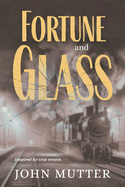
Fortune and Glass
by John Mutter
John Mutter's debut novel, Fortune and Glass, narrated by a mid-level official in Germany's Foreign Ministry before and during the Nazi era, begins with a showstopper and never lets up. In the prologue, the narrator places a pistol to the head of his former lover and pulls the trigger.
That opening sets the pace as suspense builds: the action moves between November 1943, with narrator Rudi Baumann on a train from neutral Switzerland, where he has safely deposited Sara Traum (with whom he "felt more engaged... than I did with my wife"), and October 1932, when he first met Sara. Mutter continues to cut back and forth from Rudi's present--with Adolf Hitler in charge--to the past, as the National Socialist party is just gaining a foothold in the German government.
Mutter bases Rudi Baumann on an actual person: Fritz Kolbe, an anti-Nazi in the German Foreign Ministry who personally smuggled valuable information to the Allies. Several nail-biter scenes track Rudi's movements through Berlin and then to his U.S. contact's private home in Bern, Switzerland. Through Rudi's experience, Mutter shows readers how, step by step and without ever winning a majority of the vote, Adolf Hitler and the Brown Shirts grew to crush the Communists, Social Democrats, and other parties in order to achieve absolute power for the National Socialist Party. And, astonishingly, how one man found a way to whittle away at their control.
Fortune and Glass does not bog down in a blow-by-blow account of the increasing power of the Nazis. Rather, Mutter illustrates the before and after both beautifully and terribly, as German citizens get caught up in a whirlwind of post-World War I desire to reconstitute their country to its former glory. Judiciously chosen moments elucidate the contributing factors that launched the rise of Hitler, the diverse points of view of Berliners at that time, the Germans' growing awareness of Hitler's too-ambitious plans, the decisive turn of the Red Army against Hitler, and Allied efforts in Germany. Dinner party conversation at Sara Traum's house, for instance, lays out the array of prevailing intellectuals' predictions about the elections, including those of Sara's renowned psychiatrist father, Dr. Viktor Traum; Herr Ullstein, whose family was the "biggest publisher in the country"; Herr Vetter, an executive at the UFA movie company; and Sara's uncle, who ran the most popular department store in Berlin. One of the most chilling observations comes from Ullstein: "[Germans] want daily life to unfold with precision as it did before the [Great War]. Whoever can provide that wins power." Another key scene involves Sara's brother, Sol, and his friend Max, being taunted and beaten by Brown Shirts as Berliners stand by, neither joining in nor helping the two men. Through specific instances such as these, Mutter demonstrates the ways in which the Nazis' power gradually infiltrates society at large, usurping individual rights and fostering an atmosphere of fear.
Rudi's biggest challenges erupt due to a love triangle that develops between Rudi, Sara, and Rudi's childhood friend Hans Thiele. Through Rudi's relationship with Sara, readers watch the impact on the Jewish community as Nazis target Jewish establishments--first subtly and then full-throttle. On the night of November 9, 1938, Germans "spontaneously," as the Nazis put it, attacked Jewish homes and businesses in retaliation for 17-year-old Herschel Grynszpan's Paris shooting of Ernst vom Rath, a German diplomat--what becomes known as the infamous Kristallnacht. Hans Thiele, who, Rudi says, "worked as hard for the Nazis as I did against them," rises steadily in the Nazi party. After Rudi and Sara break up and Rudi meets his future wife, he is surprised to spot Sara with Hans. The pressures of wartime force the three apart and reunite them in often astonishing ways; the triangle throws into high relief the tensions and dangers dominating Berlin, as well as a dire need for human connection.
Through Rudi's observations about Berlin, Mutter makes readers privy to its layered history. Rudi finds refuge on a bench in the Tiergarten when he discovers his apartment complex in ruins after work one evening. (Rudi had already taken his wife and children to Rügen, his wife's childhood home, for safety.) He thinks about the Brandenburg Gate as a reflection of "the struggle between progress and reaction that had raged for at least a century and a half in Germany," from its inception by Friedrich Wilhelm II, King of Prussia, to Napoleon marching victoriously through it in 1806, to Germans' reclaiming it with a Prussian eagle and Iron Cross.
As Berlin grows less recognizable to him, Rudi's efforts at thwarting the wrongs he observes start slowly. First, he protects a young Jewish woman in a neighboring apartment from the Brown Shirts, and he and his family take her in. Then he distributes resistance leaflets after curfew. And then, with the help of Sara's father, Rudi connects with the Allies.
One brave man does what he can to undermine the Nazis, at great risk not only to himself but also to his family. He watches his beloved Berlin become transformed due first to the Nazis' efforts to eradicate anyone who is not loyal to their cause, then to Allied bombings, and finally the Red Army's siege. This inspiring story prompts a central moral question: At a time when so many rules of conduct are shattered, how does one remain true to oneself and do the right thing, especially when there is not a soul to be trusted? In Mutter's thrilling World War II novel, Rudi Baumann offers a heroic example. --Jennifer M. Brown
Left Field Publishing,
$30,
hardcover, 390p., 9781966883074,
October 6, 2026
Fortune and Glass (coming October 6, 2026, from Left Field Publishing) may be John Mutter's debut novel, but he is a lifelong writer. Not just as editor-in-chief and co-founder of Shelf Awareness, but also in his devotion to writing fiction. He's a longtime World War II history buff with a particular interest in Germany, where he spent his junior year. But not until he read a biography of Fritz Kolbe, a spy working for the German Foreign Ministry whose work helped the Allies identify Germany's vulnerabilities, did this story click into place.
Has this book been incubating for a long time?
I've always been a quiet fiction writer in the corner, going back to high school. I've never felt very comfortable talking about it with people. I've written tens of thousands of stories for Publishers Weekly and Shelf Awareness, and people know that writing--no big deal. But the fiction is a special thing that I don't want anybody to touch and mess up.
How dare I call myself a writer, right?
Exactly. I did come close a couple times to getting published, but obviously it didn't happen. And then I read a biography of Fritz Kolbe. I knew nothing about his story, and I've read a lot of books about World War II. It just jumped out at me, especially because he was America's best spy in Europe during World War II.
I took some liberties with Kolbe's story, but the basics of his career are there: he was in the Foreign Ministry before the Nazis came to power, kept on, hated the Nazis, tried to figure out a way to do something against them that took advantage of all the amazing secrets he had access to. And his handler was Allen Dulles, who became the director of the CIA. I read that book, and it was like, "Oh my God, I think I found something here."
It was fascinating that the National Socialist Party actually had only a minority share of the votes but was able to crush the Communist Party, the Social Democratic Party, and the other political parties. The conversation at dinner at the Traums' home laid out the possible outcomes for Germany's future in such a natural way. How did that scene evolve?
I was familiar with all the arguments from my reading, and I did spend a junior year at the University of Munich, where, of course, I got to know many Germans. And my dad was always interested in World War II. Growing up in Westport, Conn., I had a good friend whose mother was Jewish and grew up in Vienna. Her family fled Austria when the Nazis took over. I had another friend whose father was a German Jew who left just before they closed the borders to Jews in 1938, before Kristallnacht. He was one of the last people to get out--his parents were supposed to come next, and they died. It felt like I knew a lot about it, beyond just history books. The friend's mother who fled Vienna was Doris Orgel, the children's book author.
The history of Berlin is incredible. You walk down a street, and there's something about the Soviet occupation of that part of Berlin, and then a monument to Nazi victims, and then something from the imperial era. So I was looking around for where the Traum family would have had a place. I discovered there were several of what they called villa colonies--elegant estate developments for wealthy Berliners. Villa Grunewald was the way I described it; I've walked through it. Most of it survived the bombings because it was a little bit outside the center of the city.
Readers could reconstruct Berlin based upon your descriptions of the city, through Rudi's walks in those areas of Berlin. Once you started the novel, did you need to go back and fill in the details, the way you did with the villa you described?
I went back and I walked all around that villa area, for example, and that's where I saw the little bridge I talked about with the sphinxes on it. The park where Rudi slept overnight after his apartment building was bombed is the Tiergarten, which is like the Central Park of Berlin--I had been there a bunch of times before, but I did wander around to find the secluded areas that would make good sleeping spots.
I went to Bern and Basel and Rügen, and to the Allen Dulles character's house where they met secretly--that was all real. There is a fancy facade on one side of the house, and in the back is a sort of park, a wooded slope with a path that goes down to the river.
How did you come up with the love triangle between Rudi, Sara, and Hans? It ends up being the perfect microcosm for all the tensions going on in Germany.
Certain parts of the plotting were pretty well established early on. Those three characters were there, particularly Sara and Rudi, more than Hans. Hans was an old friend, but kind of just that for a while. Sara's connection with Hans was something I came to a little later. I did always have that part, particularly when Sara and Hans first meet, and they have a funny discussion of Roosevelt and Hitler and the big election coming up in Germany in late 1932, two days before the U.S. presidential election: 'How could you vote for the Nazis?' 'How could you vote for the Communists?' There's an attraction, and then it all fell into place. The more I got into it, the more I realized it highlighted a lot of things that I wanted to highlight. It also becomes very personal for Hans, as Rudi himself says.
Can you talk about how you arrived at the structure?
I started writing it maybe 15 years ago. The original version was entirely chronological. A couple readers thought it built up a little too slowly. I've always enjoyed Erik Larson's books--they're not fiction, but there's always a dual narrative, and you can do such interesting things when you mix things up. There can be parallel moments. So then I made the whole book like that. But after a while, it didn't work as well. So I made the second half chronological. The idea of starting with a prologue, with the shooting, also came later.
It's sort of appropriate that the first part was a dual narrative that went back and forth, because so many things were up in the air, everything from whether or not the Nazis would succeed in seizing power and what they do with it, to Rudi's personal life and what can he do against the Nazis? From the middle on, where the narrative becomes chronological, so many things are settled.
Do you think Rudi was unique in the ways that he found to stand up to the Nazis? It seemed to me he felt very alone out there.
He and the few others he worked with were tight-lipped about what they were doing. And that's partly what allowed them to survive. Most of the better-known resistance groups were bigger and failed because too many people knew what they were doing, and the Nazis were merciless.
It was close to home at the University of Munich: the Scholl siblings were passing out leaflets as leaders of the White Rose, Weiße Rose, in 1943, and a university janitor turned them in; they were executed within days. Another example was a group of religious-minded people, the Confessing Church, who did things and talked about things that were critical of the Nazis, and many of them wound up in camps and a couple were executed. It was difficult for any groups to organize, and it was hard for individuals to do anything.
Fritz Kolbe was in an unusual situation of having access to amazing material; his boss was the liaison between the foreign ministry and the military, so he was looking at everything. It was striking also to be able to do courier runs--which were pretty much the way I described them. The foreign ministry was exempt from the usual Gestapo, SS kind of surveillance; their material wasn't checked on the trains.
Is there anything else you'd like readers to know about Fortune and Glass?
There are so many books about World War II and Germany and the Nazis, yet there aren't many that look at it from a day-to-day basis and how regular people were affected, especially if they were Jewish. Also Germans who maybe weren't politicized and weren't Nazis, how it affected them. There's been some terrible historical revisionism, an idea that there wasn't a Holocaust, that seems to be growing. And then the idea that all Germans were Nazis and happily killed Jews. I like being able to throw in my two pfennig about those ideas. --Jennifer M. Brown


LEFTFIELDPUBLISHING.0817.B1.FORTUNEANDGLASS3.gif)
LEFTFIELDPUBLISHING.0817.bookcover.FORTUNEANDGLASS2.png)
LEFTFIELDPUBLISHING.0817.S1.FORTUNEANDGLASS2.jpg)
LEFTFIELDPUBLISHING.0817.S2.FORTUNEANDGLASS.jpg)

LEFTFIELDPUBLISHING.0817.T1.FORTUNEANDGLASS3.jpg)
