 |
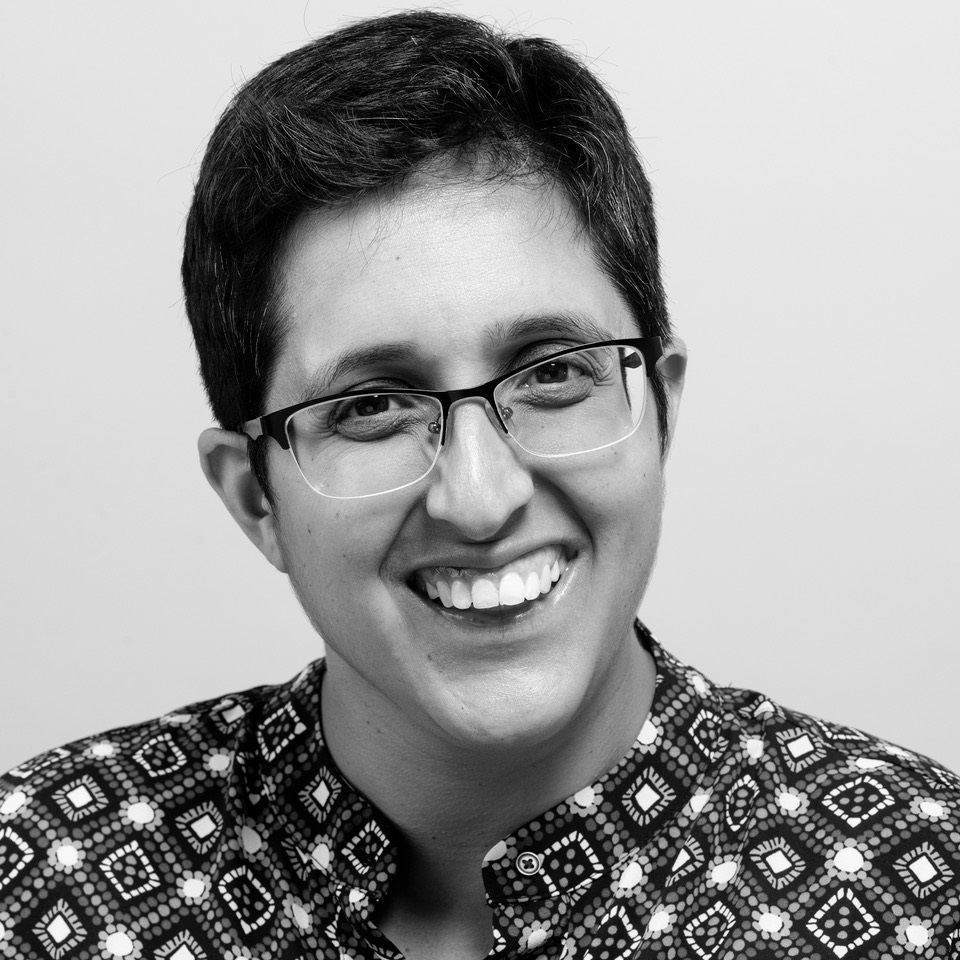
| photo: Jennifer Waddell |
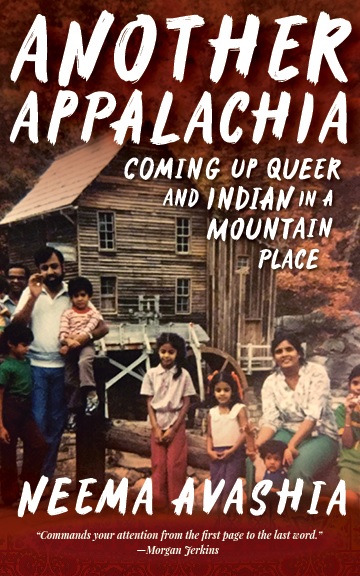
Neema Avashia was born and raised in southern West Virginia to parents who immigrated to the United States. She has been a history and civics teacher in the Boston Public Schools since 2003. Her essays have appeared in the Bitter Southerner, Catapult, Kenyon Review Online and Lithub. Her first book, Another Appalachia: Coming Up Queer and Indian in a Mountain Place (West Virginia University Press) examines Avashia's identity as a queer desi Appalachian woman, while encouraging readers to envision more complex versions of both Appalachia and the nation as a whole.
Handsell readers your book in 25 words or less:
You didn't know there were Indian people in West Virginia? Do I have the book for you!
On your nightstand now:
I just finished two excellent short story collections: Filthy Animals by Brandon Taylor and Afterparties by Anthony Veasna So, each of which explores themes of queerness and identity in the context of insular communities--in Taylor's case, grad school in Madison, Wis., where I also went. In So's case, the Cambodian American community in the Central Valley of California. Now I'm reading Unprotected by Billy Porter, which is a beautiful memoir about growing up Black and queer in Pittsburgh, finding his way in the theater world at the height of the AIDS epidemic.
Favorite book when you were a child:
Ramona Quimby, Age 8 by Beverly Cleary. My first queer role model, even though neither she, nor I, really knew anything about queerness at the time!
Your top five authors:
Jesmyn Ward is hands-down the best writer of our generation, and I am left speechless by everything she writes. I am continually inspired by Louise Erdrich's ability to write in a way that is both prolific and profound. Carter Sickels's stories are grounded in places that are so familiar to me, but also ask hard questions about how our relationships in those places are shaped by our identities. Danez Smith's poems fill my classroom with the whole range of human emotion. And Jane McCafferty's characters live in my head for years after I've met them on the page.
Book you've faked reading:
Heart of Darkness by Joseph Conrad. We were assigned to read it in high school, and every time I'd start reading it, I'd fall asleep after three pages. I never finished it, and still managed to churn out a whole term paper about it.
 Book you're an evangelist for:
I've bought at least 20 copies of World of Wonders by Aimee Nezhukumatathil for friends and family members. I love the way in which Nezhukumatathil is able to use descriptions of the natural world as entry points into her exploration of the personal. I've never read another book where every time I finished an essay, I literally sighed in satisfaction.
Book you've bought for the cover:
F*ckface by Leah Hampton. That title! The gorgeous deep blue background and the warty toad on the cover. I couldn't resist it. And every story within it confirmed that buying it was an excellent decision.
Book you hid from your parents:
Every book! I would stay up really late at night reading under the covers with a flashlight, and only go to sleep when my dad got up at 4 a.m. to head out for work at the chemical plant. I'm fairly certain he knew what I was up to, but he never called me out on it.
Book that changed your life:
Just Mercy by Bryan Stevenson changed everything about the way I understand the relationship between race, class and our system of mass incarceration. His belief that sound policy can be made only when we are proximate to those most impacted has completely shifted the way I think about my work as an educator. I'm a better human, and better teacher, for having read his work.
Favorite line from a book:
"You may not see it now," said the Princess of Pure Reason, looking knowingly at Milo's puzzled face, "but whatever we learn has a purpose and whatever we do affects everything and everyone else, if even in the tiniest way. Why, when a housefly flaps his wings, a breeze goes round the world; when a speck of dust falls to the ground, the entire planet weighs a little more; and when you stamp your foot, the earth moves slightly off its course. Whenever you laugh, gladness spreads like the ripples in the pond; and whenever you're sad, no one anywhere can be really happy. And it's much the same thing with knowledge, for whenever you learn something new, the whole world becomes that much richer." --Norton Juster, The Phantom Tollbooth
Five books you'll never part with:
My signed copies of Southernmost by Silas House, Good Talk by Mira Jacob and The Sentence by Louise Erdrich. My teenage-self's heavily annotated Letters to a Young Poet by Rainer Maria Rilke. My West Virginia Encyclopedia.
Book you most want to read again for the first time:
I wish that I could have read The Stories of Breece D'J Pancake when I was in high school, instead of stumbling on it as an Expatalachian in my late 30s. I think that encountering his narrative voice, and seeing his rendering of home and characters who resembled my friends and neighbors, would have given me such better grounding for understanding the way that the place where I grew up was shaping the stories I was trying to tell.
The YA book people are trying to ban that I think every young person should have access to:
Stamped: Racism, Anti-racism and You by Ibram X. Kendi and Jason Reynolds. We can't build an equitable world if we don't understand the roots of inequity. This book helps young people understand the roots.



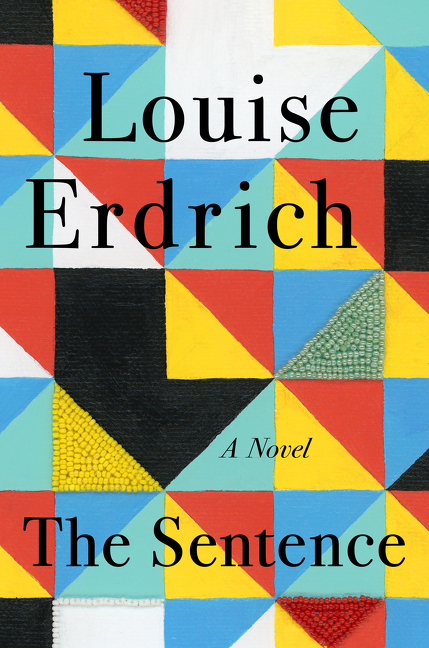 There's a lot going on in Louise Erdrich's novel The Sentence (Harper, $28.99): incarceration, genocide, global pandemic, contemporary indigenous life, intergenerational trauma, the murder of George Floyd. It is also smart and funny, and tells a love story between Tookie and Pollux.
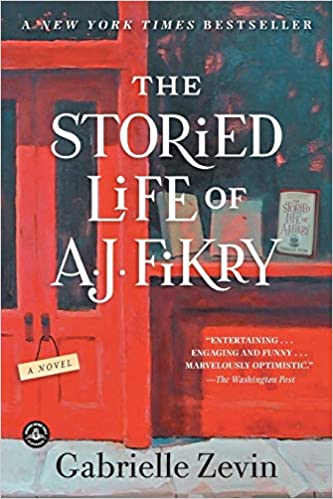 "We read to know we're not alone. We read because we are alone. We read and we are not alone. We are not alone." --A.J. Fikry, in Gabrielle Zevin's The Storied Life of A.J. Fikry (Algonquin, $16.95). This novel, with similar themes of forgiveness, healing and true love, opens with a publisher's new sales representative arriving at an independent bookstore in a summer resort island. I laughed aloud when the cantankerous owner launched into a full-page monologue listing every genre and style he disliked--including but not limited to: "postmodernist, postapocalyptic settings, postmortem narrators...." Fikry's recommended reading said more about himself than matching a reader's interests.
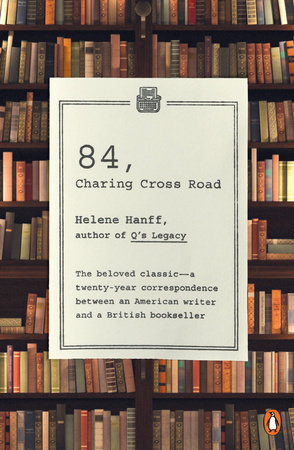 That brought to mind 84 Charing Cross Road (Penguin, $15), the post-World War II memoir featuring correspondence between the argumentative customer/author, Helene Hanff, who yearns for an inexpensive, finely bound unabridged edition of Plato's Minor Dialogues, and the reserved, witty London bookstore manager, Frank Doel, who does his best to satisfy her.